Attitudes inside Iran toward their nuclear program.
I like this approach to science writing, not so much this one. It seems to me the first respects the reader and the second doesn't. What the second is trying to illustrate are some aspects of what is called number theory. There was a light hint in the first blog in this series that it would take on development of the natural numbers and other fascinating mathematics that I was first introduced to in high school. This is a development of some of the qualities of natural numbers, but scrambled together. OTOH, if the purpose is to make mathematics "fun," then there are any number of illustrative puzzles in some older books that I monopolized from my library from grade school up. There may be some more recent books, too, but I'm not acquainted with them. I'm wondering how it looks to someone who doesn't find the Peano postulates more fun than, well, lots of things.
I haven't seen this clear a statement of sexism in a very long time. Possession of the Y chromosome equals a love of snow shovels, whether in little kids or in teh gay. I hope all you Y-chromosome types are listening to Kathleen Parker's buildup so that she doesn't have to shovel snow!
Steven Pearlstein is making a lot of sense lately. Don't call them taxes!
Tony Judt, one of the most brilliant historians we have, is paralyzed from the neck down by amyotrophic lateral sclerosis. He is writing a series of short memoirs, of which this is one. He retains his wit and good humor in his writing. I have enjoyed his work so much.
Wednesday, February 10, 2010


IPCC Credibility, Denier Credibility
For the umpteenth time, an article in yesterday's NY Times discusses what it calls a "credibility siege" of the Intergovernmental Panel on Climate Change (IPCC) and its director, Rajendra Pachauri. The articles rehearses the claims against Pachauri and the IPCC. Although a number of flagrantly false claims have been leveled against the IPCC, the two main, legitimate criticisms regard, first, Pachauri's role as occasional expert advisor to various companies and banks. He also happens to provide advice to governments and NGOs. Some of the companies, however, have donated to the NGO Pachauri also directs, The Energy and Resources Institute (TERI), based in New Delhi. And, although Pachauri earns around $50-60K per year according to his Indian tax returns, he has been called out for years now on what are alleged to be conflicts of interest. The second criticism is directed more at the entire IPCC for recent lapses in scientific rigor, including citing a claim in its most recent, Fourth Report about the rate of Himalayan glacier melting which the original scientist has since retracted. The IPCC has responded here.
I suggest you read through the links and judge for yourself. Consider also that some 450 scientists were involved as lead authors in drafting the Fourth IPCC Report, with an additional 800 as contributing authors, and another 2500 as reviewers. You're bound to get a wanker or two doing shoddy work, not following the IPCC's own principles and procedures (pdf). Doesn't excuse the shoddiness and stupidity, of course. And my own view is that Pachauri ought to resign - he's non-essential to a task that is essential. The lapses say nothing about the reality of climate change, however.
But the reality of the science also illustrates that criticism from most climate skeptics is highly selective from a massive amount of studies, claims, reports, etc.
Further, in addition to oil industry funding of several key thinktank climate deniers, we ought to take a look at some of the most public skeptics themselves. Lord Christopher Monckton, 3rd Viscount Monckton of Brentley, who has a training in classics and journalism, has taken on perhaps the most public climate skeptic role. He refers to climate change as an invention of the political left in the name of taking over the world and spends much of his time away from reading the classics disputing climate science. One major political tool has been not simply to dispute the science but to misrepresent some climate scientists' claims altogether for political (and often economic) gain or to destroy the reputations of climate scientists.
As I've said before, legitimate criticism and skepticism is essential to good, rigorous science (and philosophy, economics, etc.). See Cheryl's post here too. And there are uncertainties in climate science as there are almost by definition in any science or pursuit of knowledge. Most of the legitimate criticism and skepticism goes unreported or underreported, actually, because it's all academic-y. Public spokespeople add their own language for public consumption. Much of this comes out of the politically volatile mix of over 1000 climate change lobby groups.
But the issue of climate change is not simply a matter of science. The science provides us with a basis for our decision-making and its substance. The problem of climate change is largely a matter of the effects of climate change on human beings and ecosystems, and how then the science might inform our thinking about our economies, politics, and ethics. In other words, legitimate climate change disputes are also about policy. The thing is that we can only make intelligent policy decisions to the best of our current abilities, decisions about the future well-being of our progeny, if the empirical descriptions we have of the world are accurate. And there are then very real policy discussions to be had involving different, competing values.
I think there's a pretty big difference between shoddy science that was essentially an unsubstantiated claim retracted when discovered, and making unsubstantiated and unsubstantiable claims deliberately.
I suggest you read through the links and judge for yourself. Consider also that some 450 scientists were involved as lead authors in drafting the Fourth IPCC Report, with an additional 800 as contributing authors, and another 2500 as reviewers. You're bound to get a wanker or two doing shoddy work, not following the IPCC's own principles and procedures (pdf). Doesn't excuse the shoddiness and stupidity, of course. And my own view is that Pachauri ought to resign - he's non-essential to a task that is essential. The lapses say nothing about the reality of climate change, however.
But the reality of the science also illustrates that criticism from most climate skeptics is highly selective from a massive amount of studies, claims, reports, etc.
Further, in addition to oil industry funding of several key thinktank climate deniers, we ought to take a look at some of the most public skeptics themselves. Lord Christopher Monckton, 3rd Viscount Monckton of Brentley, who has a training in classics and journalism, has taken on perhaps the most public climate skeptic role. He refers to climate change as an invention of the political left in the name of taking over the world and spends much of his time away from reading the classics disputing climate science. One major political tool has been not simply to dispute the science but to misrepresent some climate scientists' claims altogether for political (and often economic) gain or to destroy the reputations of climate scientists.
As I've said before, legitimate criticism and skepticism is essential to good, rigorous science (and philosophy, economics, etc.). See Cheryl's post here too. And there are uncertainties in climate science as there are almost by definition in any science or pursuit of knowledge. Most of the legitimate criticism and skepticism goes unreported or underreported, actually, because it's all academic-y. Public spokespeople add their own language for public consumption. Much of this comes out of the politically volatile mix of over 1000 climate change lobby groups.
But the issue of climate change is not simply a matter of science. The science provides us with a basis for our decision-making and its substance. The problem of climate change is largely a matter of the effects of climate change on human beings and ecosystems, and how then the science might inform our thinking about our economies, politics, and ethics. In other words, legitimate climate change disputes are also about policy. The thing is that we can only make intelligent policy decisions to the best of our current abilities, decisions about the future well-being of our progeny, if the empirical descriptions we have of the world are accurate. And there are then very real policy discussions to be had involving different, competing values.
I think there's a pretty big difference between shoddy science that was essentially an unsubstantiated claim retracted when discovered, and making unsubstantiated and unsubstantiable claims deliberately.

Torture Notes
A UK court has forced the British government to release documents showing that the US authorities tortured detainee Binyam Mohamed while in CIA custody in Pakistan. The stress positions and sleep deprivation used on Mohamed are banned by the UK in a law dating to 1972 and the conflict in Northern Ireland. The British army has already broken that law (and here).
Andrew Sullivan, adding to the case made by Yglesias, obliterates Marc Thiessen's attempt to say that US torture is nothing like Nazi or Khmer Rouge torture.
A key figure in Bush administration war commissions, William Lietzau, is hired by the Obama administration Defense Department as deputy assistant secretary for detainee affairs.
If you haven't read this important piece, Scott Horton lays out the case of the Guantánamo "suicides." Sullivan discusses further in the Times Online. Update by Scott here.
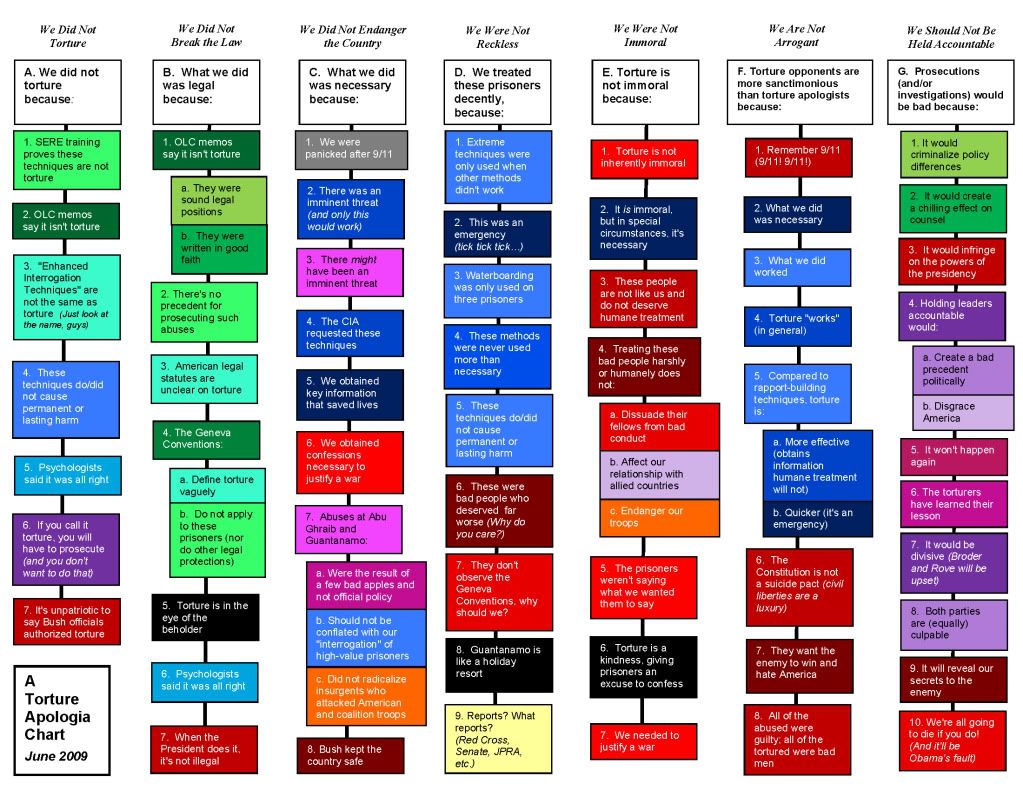
Plus, a clearing house illustration of torture apologia. The number of really bad arguments and claims made in torture's defense is stunning. The pro-torture people really really want it.
Andrew Sullivan, adding to the case made by Yglesias, obliterates Marc Thiessen's attempt to say that US torture is nothing like Nazi or Khmer Rouge torture.
A key figure in Bush administration war commissions, William Lietzau, is hired by the Obama administration Defense Department as deputy assistant secretary for detainee affairs.
If you haven't read this important piece, Scott Horton lays out the case of the Guantánamo "suicides." Sullivan discusses further in the Times Online. Update by Scott here.
Plus, a clearing house illustration of torture apologia. The number of really bad arguments and claims made in torture's defense is stunning. The pro-torture people really really want it.
Tuesday, February 09, 2010
Monsanto Moratorium in India
The Indian High Court has just ruled to delay indefinitely the introduction of bt-brinjal here, a genetically modified eggplant introduced by a company (Mahyco) that is 26% owned by Monsanto.
Here's the Environment Minister, Jiram Ramesh, talking some some sense in the Indian Express:
Instead, the problem is that private-sector ag models have resulted in patents and lawsuits and harassment and intimidation of the people who grow our food. These are problems. Is private ag research a bad thing? Not at all. Bullying farmers whose non-GM crops happen to be contaminated by Monsanto's own? That's a bad thing. And I think India is wise, for now, to be avoiding it.
Here's the conclusion from a NYT editorial last October. It's akin to the point Ramesh is making:
Here's the Environment Minister, Jiram Ramesh, talking some some sense in the Indian Express:
We cannot depend on private sector to drive the biotechnology research in our agriculture sector . . . India's first green revolution was not powered by the private sector. And there is no reason to believe that the second green revolution would be driven by private companies.The debate has largely focused -- predictably -- on safety issues; indeed, it's the only focus of the NYT article linked in the title. But Ramesh, here, is practically alone in calling attention to another serious concern. It isn't that the agribusiness model is non-Indian or Western or too scientific (Norman Borlaug's recent passing was noted with much sorrow in the national press, here, where he was widely appreciated).
Instead, the problem is that private-sector ag models have resulted in patents and lawsuits and harassment and intimidation of the people who grow our food. These are problems. Is private ag research a bad thing? Not at all. Bullying farmers whose non-GM crops happen to be contaminated by Monsanto's own? That's a bad thing. And I think India is wise, for now, to be avoiding it.
Here's the conclusion from a NYT editorial last October. It's akin to the point Ramesh is making:
Agriculture is at the frontier of technological progress. Its innovations will determine, to a large extent, whether and at what cost this country and the world will be able to feed its growing populations. No company should dominate such an essential business.[Sharp-eyed phronauts will recognize Jiram Ramesh as the same guy who called bullshit on the IPCC's conclusion that the Himalayan glaciers would be gone by 2035. The problem isn't that the glaciers aren't melting; it's that those advocating policy to address climate change need credible evidence in place of speculation, especially from bodies like the IPCC.]


The Haggle and the Macho Match
Juan Cole today quotes Ali Akbar Salehi, the head of Iran's Atomic Energy Organization, as saying
I am probably the world's worst haggler. When I try to analyze this situation in those terms, there's an awful lot that doesn't make sense. That could be my haggling inadequacies or it could be that the parties are not making sense in their bargaining.
There seem to be two things going on: a haggle and a macho match. The two can be combined in diplomatic negotiations, but the addition of too much macho, it seems to me, has poisoned a compromise for both sides. Add in the uncertainties of who is speaking for the Iranian government and the internal changes of personnel and policy, and it’s not clear that any agreement will be possible.
Not showing weakness may be a reasonable strategy in international negotations. Of course, there’s that kind of strength and there’s the kind of strength that can dare to show weakness. The US and other P5+1 have that kind of strength, but whether it is wise to show weakness in this way depends on the situation, and the way Iran has presented its case has had aspects of forcing a show of weakness on the part of the P5+1, which makes it much more difficult to do, even from a position of unquestioned military and economic strength. To be sure, the Iranians may feel that the P5+1 has been playing a similar game, hoping to force Iran to take their offer without modification. I’m talking about perception, not intentions. Whatever the intentions, if either side accepts the other’s position, it involves a certain amount of humiliation.
That’s the macho side of the interaction. As Cole noted, Saddam Hussein was playing the macho game too, and the Iranians might well note what it got him. And there are additional macho players within Iran and the bomb-Iran faction outside.
The macho game has brought both sides to a place where they can’t move. The haggle is the part I don’t understand, which may be my inadequacies or it may be the strange moves Iran is making, most probably because of their internal disagreements.
I will oversimplify and say you want to buy a rug in the bazaar. You offer $50 and the merchant says, no, $500. That's the start, and we expect that the two will be some distance apart. With various protestations of not having any more money in your wallet and the prospect that his children will go hungry, you get to $150 offered and $200 demanded. Suddenly another guy jumps up from behind the stall and says that he’s really the one in charge and for just ten dollars more ($160), you can have the rug, and at the same time the guy you’ve been negotiating with says no, he really can't let it go for less than $450. It seems to me that that is the current state of the Iranian negotations.
The question is who has the power in this negotiation. It seems to me unquestionable that it's not Iran in terms of military and economic might, to the extent that sanctions work. What power Iran has is to move toward a nuclear weapons program. That's a very negative sort of power and potentially involves a great deal of international disapprobation, not to mention Israel's nuclear arsenal. But Iran behaves as though it possesses the greater power.
That's nice for a bluff, I guess, and at this point we get into the kind of haggling that is simply incomprehensible to me. It's also like poker, which I have finally come to terms with as a pastime that people enjoy but is quite outside what I consider pleasurable.
I think there's misjudgement on both sides here as to what each can do, and perhaps a deliberate attempt by both sides to break the other. Humiliate yourselves and offer us the uranium in desperation to make us stop enriching, say the Iranians. Humiliate yourselves and agree that we've given you a good bargain, say the P5+1. What has been offered by the P5+1 is indeed a good bargain, bringing Iran into nuclear commerce with the rest of the world and allowing them to continue enriching to reactor grade. It might have been better haggling for the P5+1 to have offered something more imperfect and allowed the Iranians to have saved some face by offering their modifications, which could have been accepted.
I don't quite understand why the P5+1/IAEA have been so rigid in response to the Iranians' desire to modify their offer. Some of what the Iranians have suggested (like the location of the swap) seems innocuous to me. The time-delay stuff, not so much.
I think that part of the Iranian dance, with those guys popping up from behind the stall, has been their internal disagreements and power struggles. But their changing presentations of their position do not inspire confidence, particularly given their less-than-candid performance with the IAEA.
It’s probably a good thing that I’m not in charge of the negotiations. I really don’t know where I’d go from here. The Obama administration was buying time by letting the negotiations drag at the end of the year, but the Iranian claim of moving up the enrichment to 19.75% ups the urgency. Cole was not quite right yesterday in saying that the increased level of enrichment changes nothing; the time to a bomb, if that is the intention, is still fairly long. But the higher enrichment will teach the Iranians more of what they need to know to get there. It would be better if they did not do this.
Mr President [Ahmadinejad] made the comment in a subtle way. If you paid attention to his comments, he said: Start the 20-per cent enrichment, but the doors for cooperation are still open and we are still ready for fuel swap. In other words, we - although we will start the 20-per cent enrichment tomorrow - will stop the enrichment as soon as they (West) come to their senses and provide our fuel.There are a number of ways to parse this; they will stop the 20% enrichment? all enrichment? The fuel must come tomorrow? Unfortunately, this kind of uncertainty clings to all statements on the subject coming out of Iran.
I am probably the world's worst haggler. When I try to analyze this situation in those terms, there's an awful lot that doesn't make sense. That could be my haggling inadequacies or it could be that the parties are not making sense in their bargaining.
There seem to be two things going on: a haggle and a macho match. The two can be combined in diplomatic negotiations, but the addition of too much macho, it seems to me, has poisoned a compromise for both sides. Add in the uncertainties of who is speaking for the Iranian government and the internal changes of personnel and policy, and it’s not clear that any agreement will be possible.
Not showing weakness may be a reasonable strategy in international negotations. Of course, there’s that kind of strength and there’s the kind of strength that can dare to show weakness. The US and other P5+1 have that kind of strength, but whether it is wise to show weakness in this way depends on the situation, and the way Iran has presented its case has had aspects of forcing a show of weakness on the part of the P5+1, which makes it much more difficult to do, even from a position of unquestioned military and economic strength. To be sure, the Iranians may feel that the P5+1 has been playing a similar game, hoping to force Iran to take their offer without modification. I’m talking about perception, not intentions. Whatever the intentions, if either side accepts the other’s position, it involves a certain amount of humiliation.
That’s the macho side of the interaction. As Cole noted, Saddam Hussein was playing the macho game too, and the Iranians might well note what it got him. And there are additional macho players within Iran and the bomb-Iran faction outside.
The macho game has brought both sides to a place where they can’t move. The haggle is the part I don’t understand, which may be my inadequacies or it may be the strange moves Iran is making, most probably because of their internal disagreements.
I will oversimplify and say you want to buy a rug in the bazaar. You offer $50 and the merchant says, no, $500. That's the start, and we expect that the two will be some distance apart. With various protestations of not having any more money in your wallet and the prospect that his children will go hungry, you get to $150 offered and $200 demanded. Suddenly another guy jumps up from behind the stall and says that he’s really the one in charge and for just ten dollars more ($160), you can have the rug, and at the same time the guy you’ve been negotiating with says no, he really can't let it go for less than $450. It seems to me that that is the current state of the Iranian negotations.
The question is who has the power in this negotiation. It seems to me unquestionable that it's not Iran in terms of military and economic might, to the extent that sanctions work. What power Iran has is to move toward a nuclear weapons program. That's a very negative sort of power and potentially involves a great deal of international disapprobation, not to mention Israel's nuclear arsenal. But Iran behaves as though it possesses the greater power.
That's nice for a bluff, I guess, and at this point we get into the kind of haggling that is simply incomprehensible to me. It's also like poker, which I have finally come to terms with as a pastime that people enjoy but is quite outside what I consider pleasurable.
I think there's misjudgement on both sides here as to what each can do, and perhaps a deliberate attempt by both sides to break the other. Humiliate yourselves and offer us the uranium in desperation to make us stop enriching, say the Iranians. Humiliate yourselves and agree that we've given you a good bargain, say the P5+1. What has been offered by the P5+1 is indeed a good bargain, bringing Iran into nuclear commerce with the rest of the world and allowing them to continue enriching to reactor grade. It might have been better haggling for the P5+1 to have offered something more imperfect and allowed the Iranians to have saved some face by offering their modifications, which could have been accepted.
I don't quite understand why the P5+1/IAEA have been so rigid in response to the Iranians' desire to modify their offer. Some of what the Iranians have suggested (like the location of the swap) seems innocuous to me. The time-delay stuff, not so much.
I think that part of the Iranian dance, with those guys popping up from behind the stall, has been their internal disagreements and power struggles. But their changing presentations of their position do not inspire confidence, particularly given their less-than-candid performance with the IAEA.
It’s probably a good thing that I’m not in charge of the negotiations. I really don’t know where I’d go from here. The Obama administration was buying time by letting the negotiations drag at the end of the year, but the Iranian claim of moving up the enrichment to 19.75% ups the urgency. Cole was not quite right yesterday in saying that the increased level of enrichment changes nothing; the time to a bomb, if that is the intention, is still fairly long. But the higher enrichment will teach the Iranians more of what they need to know to get there. It would be better if they did not do this.
Monday, February 08, 2010
Q --> N
Stephen Walt has an eerie piece today on how Tony Blair's testimony supports Walt's and Mearsheimer's thesis that the Israel lobby had a lot to do with setting up the Iraq war. He barely mentions that other country. But here's something to consider:

Finally, let's not forget that while the Iraq war has been a disaster for the United States, it has also been very bad for Israel, not just because its principal patron has been stuck in a quagmire in Iraq, but also because the biggest winner from the war was Iran, which is the country that Israel fears most. All of this shows that despite the lobby's openly-stated commitment to promoting policies that it thinks will benefit Israel, it did not work out that way with the Iraq war.

Bits and Pieces - February 8, 2010
It's kind of amazing that they didn't keep a log of people on-site at that power plant in Connecticut. It's usually a safety and security requirement.
Another use for those pesky interwebs.
Secret caves of the Lizard People. Under Los Angeles - bet you could have guessed.
Zogby on the tea partiers.
I think I've highlighted before that the voters of Oregon approved new taxes rather than eliminate services, but Dean Baker points out that that happily progressive vote got lost in the "sky is falling" fear of the Massachusetts vote. And the first comment probably gets it right, too.
A graphic to give you some intuitive feeling for the Obama budget.
Another use for those pesky interwebs.
Secret caves of the Lizard People. Under Los Angeles - bet you could have guessed.
Zogby on the tea partiers.
I think I've highlighted before that the voters of Oregon approved new taxes rather than eliminate services, but Dean Baker points out that that happily progressive vote got lost in the "sky is falling" fear of the Massachusetts vote. And the first comment probably gets it right, too.
A graphic to give you some intuitive feeling for the Obama budget.
A Post About Ignorance and Politics
If we're able to achieve something we desire - and successfully repeat that ability - we must have some knowledge of what we want, the context of the wanting, the object itself, and at least a simple methodology or various methodologies for obtaining it. When we're ignorant, we hit upon that thing we desire mainly by accident, if at all. If we don't learn anything at all from the event, it's unlikely we'll ever achieve that thing we desire again.
We're all pretty obviously ignorant to varying degrees. The issue is the celebration of ignorance. Only in the US can you find willful ignorance elevated to a marker of pride. This is exceedingly strange since ignorance has no apparent value, whether intrinsic or instrumental, other than maybe to be able to say that you're not like some people who know stuff (like egghead "liberal elites"). Power has always loved it, however. An ignorant populace is the source of sustained power.
Knowing stuff is both intrinsically good and really useful. The process of coming to know and understand things (i.e. learning) is also good and enjoyable and instrumentally valuable. Since we're fallible beings, there exists the ever-present possibility that we may be mistaken about even the things we think are most profoundly true. Knowing and learning as processes help us temper the consequences of our fallibility.
While the issue usually seems to be epistemological, it's also ethical. Celebrating knowledge and learning is indeed better than celebrating ignorance because of the abundant good and goods the former provides individuals and society. Celebrating ignorance endangers us all.
We're all pretty obviously ignorant to varying degrees. The issue is the celebration of ignorance. Only in the US can you find willful ignorance elevated to a marker of pride. This is exceedingly strange since ignorance has no apparent value, whether intrinsic or instrumental, other than maybe to be able to say that you're not like some people who know stuff (like egghead "liberal elites"). Power has always loved it, however. An ignorant populace is the source of sustained power.
Knowing stuff is both intrinsically good and really useful. The process of coming to know and understand things (i.e. learning) is also good and enjoyable and instrumentally valuable. Since we're fallible beings, there exists the ever-present possibility that we may be mistaken about even the things we think are most profoundly true. Knowing and learning as processes help us temper the consequences of our fallibility.
While the issue usually seems to be epistemological, it's also ethical. Celebrating knowledge and learning is indeed better than celebrating ignorance because of the abundant good and goods the former provides individuals and society. Celebrating ignorance endangers us all.
NOAA's New Climate Portal
 NOAA has a spiffy new portal site for data on climate change (thanks, JE). It's got some cool gadgets too, especially the Global Climate Dashboard. (Chart above is sea level rise in feet from about 1950 to 2009).
Watership Down

The cold I've had for the past few days muddled my brain sufficiently that I couldn't read my usual mix of current-events magazines. So I pulled Watership Down off the shelf and read it again. I added a little fun to it by pulling my European bird and plant guides off the shelf too, and looked up the birds and plants I didn't know that were referred to in the book. I'm always amazed that there are so many of both of them that are so different from what we have in North America.
I first read Watership Down at the urging of one of my mentors, not too long after the book first came out. "Rabbits?" I said. "Yes," he said, "but what rabbits!" Hazel's style of leadership became one of my models: let everyone define their own contributions, give credit whenever you can, and take every good idea and opportunity that comes along.
The picture at the top is taken from here, to whom I am very much indebted. Good Watership Down pictures are hard to come by on the Web. This one is from the film, which I haven't seen. That must be Hazel on the right, watching while Blackberry, the innovator and practical solutions rabbit, checks out the board that will take Fiver, the seer, and Pipkin, the little guy, across the river early in their adventures.
It's a good book for kids, too, perhaps a little dark in places. And just a good read and way to learn more of the European birds and plants.
Correction: That's Hazel testing out the board, and Blackberry standing to the side. Just what you'd expect from a good leader.
Sunday, February 07, 2010

Saturday, February 06, 2010
Controlling the Dialog
Joe Romm today focuses his wrath on a (very long and repetitive) piece in Washington Post Outlook entitled “Why are liberals so condescending?” No I won't give the WaPo a link. See what Joe has to say and click from there if you feel the need to read this sort of thing again.
But just as the terrorists win if you become terrified, this meme (which has appeared in MSM, various magazines purporting to be liberal, and over and over again on discussion boards), the conservatives win if liberals take this bosh seriously. It, of course, plays into the ever-popular conservative meme of victimization and thereby gives the conservative base a feel-good reflex, along with another way to bash liberals. A double win for conservatives.
But there's more. These articles and screeds are designed to tilt the playing field away from fact and toward an acceptance that all viewpoints are equally valid. It also makes liberals like Romm irritated and perhaps a bit sheepish; we're nice people, we're not condescending. Joe stays on the attack throughout his piece, but I think he's missing the point that the WaPo piece is designed to make him waste his time refuting it. And, as he refutes it, referring snobbily to fact as something that might be privileged above opinion or divine revelation, he provides more material from which conservatives can claim liberal condescension.
And more timid liberals might pull back on their arguments to allow that, for example, the conservatives have a point about freedom of religion meaning that Pat Robertson should be allowed to say that the Haitians had it coming from his God. And in doing so, they move toward validating insane viewpoints. And the conservatives can notch up the craziness.
To the casual onlooker, the spat may look like the poor conservatives are just trying to get a word in edgewise.
It's a nice little trap.
But just as the terrorists win if you become terrified, this meme (which has appeared in MSM, various magazines purporting to be liberal, and over and over again on discussion boards), the conservatives win if liberals take this bosh seriously. It, of course, plays into the ever-popular conservative meme of victimization and thereby gives the conservative base a feel-good reflex, along with another way to bash liberals. A double win for conservatives.
But there's more. These articles and screeds are designed to tilt the playing field away from fact and toward an acceptance that all viewpoints are equally valid. It also makes liberals like Romm irritated and perhaps a bit sheepish; we're nice people, we're not condescending. Joe stays on the attack throughout his piece, but I think he's missing the point that the WaPo piece is designed to make him waste his time refuting it. And, as he refutes it, referring snobbily to fact as something that might be privileged above opinion or divine revelation, he provides more material from which conservatives can claim liberal condescension.
And more timid liberals might pull back on their arguments to allow that, for example, the conservatives have a point about freedom of religion meaning that Pat Robertson should be allowed to say that the Haitians had it coming from his God. And in doing so, they move toward validating insane viewpoints. And the conservatives can notch up the craziness.
To the casual onlooker, the spat may look like the poor conservatives are just trying to get a word in edgewise.
It's a nice little trap.
Friday, February 05, 2010
Bits and Pieces - February 5, 2010
I think I'll post the data I'm picking up in my quest for that GUTR.
The budget deficit hysteria.
Yesterday, Ezra told us that Lawrence Lessig's piece about the corruption of Congress would be the topic du jour in the blogosphere. But I guess Richard Shelby didn't want that to happen.
Republicans all think alike. I should say that I have a couple of Republican friends who get upset when I say stuff like this. The other day I amended it to "self-identified Republicans," and that seemed to work better for them. Both of them feel that they can make a difference by maintaining their membership in the group while distancing themselves from teh Crazy.
Paul Krugman reminds us why Poland never became a great power.
If you're a conservative Christian who believes the husband is head of the family and superior to you as a woman, this shouldn't be surprising.
Now I'm moving out of the strictly political stuff. But I think this article is relevant. If you've never seen someone die of whooping cough, or lost a classmate to polio with the concomitant summer restrictions, or heard your mother tell you how two of her siblings died of diphtheria and she nearly did, then it's easy to believe that your baby's crying at the needle is a portent of dreadful things to come. But this was another flat-out lie, which, unfortunately, The Lancet believed. The things we take for granted keep changing.
Armenia and Turkey are struggling to reestablish a decent relationship.
Doctors' egos kill. Just like they did with childbed fever.
And, finally, that little bit of hope left in Pandora's box (I couldn't really work this out for "Avatar," though), a visit with gorillas.
The budget deficit hysteria.
Yesterday, Ezra told us that Lawrence Lessig's piece about the corruption of Congress would be the topic du jour in the blogosphere. But I guess Richard Shelby didn't want that to happen.
Republicans all think alike. I should say that I have a couple of Republican friends who get upset when I say stuff like this. The other day I amended it to "self-identified Republicans," and that seemed to work better for them. Both of them feel that they can make a difference by maintaining their membership in the group while distancing themselves from teh Crazy.
Paul Krugman reminds us why Poland never became a great power.
If you're a conservative Christian who believes the husband is head of the family and superior to you as a woman, this shouldn't be surprising.
Now I'm moving out of the strictly political stuff. But I think this article is relevant. If you've never seen someone die of whooping cough, or lost a classmate to polio with the concomitant summer restrictions, or heard your mother tell you how two of her siblings died of diphtheria and she nearly did, then it's easy to believe that your baby's crying at the needle is a portent of dreadful things to come. But this was another flat-out lie, which, unfortunately, The Lancet believed. The things we take for granted keep changing.
Armenia and Turkey are struggling to reestablish a decent relationship.
Doctors' egos kill. Just like they did with childbed fever.
And, finally, that little bit of hope left in Pandora's box (I couldn't really work this out for "Avatar," though), a visit with gorillas.
We moved on and found ourselves in a small cluster of gorillas. The young ones rushed around and brushed up against us. Their mothers watched cautiously. And then something happened that continues to haunt me. There was a mother with a baby. We stopped to look and she held it up for us to see.
Historical Parallels
I’ve been trying to figure out what is wrong with the Republicans. I have started writing a number of posts on the subject and rejected them. I would love to come up with a Grand Unified Theory of Republicans (GUTR), but it is eluding me so far. I’d like to lay bare the essence of their seemingly boundless hatred for so many things. I’d like to find a way to talk to them, not least because a member of my family has been absorbed into the Craziness, and bring them back to an America that I can recognize. Not necessarily agree with, but recognize.
Part of the problem is that the Craziness emerges in so many ways.
I have been suffering from a cold all week, and my judgement probably isn’t the best, but Steven Walt made me post this.
Yesterday I began one of my failed GUTR posts this way:
I do like me some historical parallels. Of course, we have Godwin’s Law to remind us how overused this one is, most of the time not a parallel at all, but rather name-calling. So I’ll just note the parallels now in my and Walt’s and West’s thinking so I don’t do it later, in my GUTR post.
Update: Huh. Must be something about too much snow. Tim Rutten is even more careful than Walt, mentioning Weimar toward the end of his op-ed. But Jon Taplin lets it all hang out.
Part of the problem is that the Craziness emerges in so many ways.
I have been suffering from a cold all week, and my judgement probably isn’t the best, but Steven Walt made me post this.
Yesterday I began one of my failed GUTR posts this way:
A few years back, I attended an entertaining series of lectures by Jay West of Middlebury College. The topic was the rise of Naziism in Germany. “How did a highly civilized nation jump the tracks so badly?” he kept asking throughout the week. It wasn’t clear that there was an answer, but we were treated to a wide variety of sources and influences.Walt this morning ruminates on how to discredit Mein Kampf. Walt is much more careful than I am.
So I find myself asking how one of America’s two political parties has jumped the tracks so badly and not finding an answer. But perhaps ruminating over sources and influences will be entertaining.
Books like Mein Kampf remind us that bizarre, incoherent, and hateful ideas can sometimes win over enough people to sway a nation and ultimately help lead to the deaths of millions. When you actually look at the the book, and read about the history of Nazism, it may be hard to believe that serious people in an advanced society could be persuaded by arguments of this sort. But they were. And while Hitler may be the extreme case, we live in an era where plenty of political (and I regret to say, religious) figures offer all sorts of memoirs and tracts of their own, some of them nearly as bizarre and illogical (if not as murderous) as Hitler's infamous tome. And I regret to say that some of them have a significant following.That would seem to parallel what I’ve been thinking.
I do like me some historical parallels. Of course, we have Godwin’s Law to remind us how overused this one is, most of the time not a parallel at all, but rather name-calling. So I’ll just note the parallels now in my and Walt’s and West’s thinking so I don’t do it later, in my GUTR post.
Update: Huh. Must be something about too much snow. Tim Rutten is even more careful than Walt, mentioning Weimar toward the end of his op-ed. But Jon Taplin lets it all hang out.
Snowpocalypse Now II: The Blitz
 A specter is haunting Washington, DC. The giant snow is at our Friday doorstep. Is it not enough to have suffered the big one in December, called "Snowpocalypse"? Yes, I have lived with the creeping guilt of hearing from the distant warmth of Copenhagen the tragic accounts of that temporarily inconvenient struggle against a wrathful god. Now in DC, we have endured a couple of fiv'-inchers during the past quarter moon, but nothing in our weary souls has truly prepared us for Snowpocalypse II (represented graphically here). We're anticipating over a foot of snow tomorrow and Saturday, possibly two feet. I try to calm my trembling hand as pen touches paper haltingly in full knowledge that such circumstances condemn both extended soul and inert paper to dust in the wind,... all we are is dust in the wind.
 Sex scandals, China, and snow bring this proud, unmentionably segregated town to its knees. Schools close to save starving children, universities synchronize sick days with capricious nature, government urgently provisions unpaid leave. Bus drivers become a multitude of Mr. Scotts giving it all they have til they can nae give it no more, Captain, to propel their steely crafts up 5-degree slopes. Our organic grocery store was cleaned out tonight by the huddling upper middle class masses. No fruit or vegetables left on the shelves except for a few moldy onions and mushy bananas alone and forgotten like Charlie Brown's Christmas tree. Long lines at checkout of jostling, frightened customers - "no,... excuse you." Desperately hungry and thirsty, and concerned about supporting plastic packaging, Mrs. H and I scavenged what we could: two cans of pickled jalapenos, a jar of Nutella, roasted red pepper hummus, whole wheat penne rigate, 1lb 8oz of my favorite French roast, a medium-body, moderately tannic Malbec, and a six of Prohibition Ale from San Francisco. Mentally calculating our most basic needs, I also purchased 4 pounds of nails, 10 shanty boards, a mantle tree iron, and two casks of lime. We felt blessed that our under-fifteen items qualified us for the Express lane.
 I've seen this before. In Paris, in the early 1990s, when the US bombed Serbia, citizens in some quarters ran to the stores to buy the remaining stocks of rice and flour, butter and endives. I've seen it as a child in Vietnam in 1975, too, in a Dark Side of the Moon, sheepskin rug kind of way. But this is different, transcendent, a splendorous sublimity of catastrophe.
I will try to blog until the last drop of blood has been drained from my Netflixing, Malbec sipping, idly net-surfing, crêpe-mangeur body.
Pray for us. Pray for us as we crouch at the center of the political universe, pleading with our Double Chin leaders to lead us from our plight. God help us all.
And, don't forget, God Bless America! We shall survive, procreate, consume!

Thursday, February 04, 2010
Bits and Pieces - February 4, 2010
Defense Contractors and International Development
Alanna Shaikh points out a trend and makes some good points about it. It seems that defense contractors are buying up smaller companies that contract to USAID. Shaikh wonders what that is likely to do to the shape of international development.
Let me provide some background for those who thought that it was mainly NGOs and other do-gooder organizations who did international development. This came as a surprise to me when I first recognized it, but there are companies that specialize in contracting to the US government to provide development services. And the management for those services. There are companies along the Washington Beltway that you may never have heard of, but they're vying to supply services of all kinds that may be needed in international development. And when the US gives a "grant" to a country for development, that grant generally must be spent in the United States. Unless the people with the grant understand quite a bit about American industry, they will probably get one of these firms to do the development work, rather than the industrial firms that actually engage in trade relevant to the expertise. So you might think that a mining company might have the most expertise to develop a waste-minimization solution for minerals processing, but a bunch of these Beltway types will bid on the contract.
Shaikh is writing about a new trend: the big defense firms (she mentions DynCorp and L-3) are buying up these smaller Beltway firms.
In one way, it's not new. In the 1980s, when defense budgets were going down and environmental restoration budgets were going up, the defense firms were buying up smaller environmental firms. Evidently the managers of the defense firms believe that international development budgets will increase for the next several years, which is a good thing.
Shaikh points out several not-so-good things: that the big companies will push the shape of international development toward the kinds of project they prefer, and that humanitarian considerations are likely to be trampled, along with all aid workers being tarred with the corporate brush.
On thinking back to the eighties, I can come up with another downside. The government contracting environment inherently has very little real competition, particularly for the big defense firms. The environmental technologies acquired during the eighties haven't been developed. The companies that might have developed them were absorbed into those big defense firms and disappeared. Whatever management innovations the smaller firms might have made didn't happen.
For the defense firms, there are two reasons to acquire smaller firms in a budgetarily "hot" area: to beef up their qualifications for government contracts and to eliminate competition. They did both of these quite effectively in the 1980s, but the benefits to the public in technology development and environmental cleanup were much less.
Looks like the managements liked the strategy, though.
Let me provide some background for those who thought that it was mainly NGOs and other do-gooder organizations who did international development. This came as a surprise to me when I first recognized it, but there are companies that specialize in contracting to the US government to provide development services. And the management for those services. There are companies along the Washington Beltway that you may never have heard of, but they're vying to supply services of all kinds that may be needed in international development. And when the US gives a "grant" to a country for development, that grant generally must be spent in the United States. Unless the people with the grant understand quite a bit about American industry, they will probably get one of these firms to do the development work, rather than the industrial firms that actually engage in trade relevant to the expertise. So you might think that a mining company might have the most expertise to develop a waste-minimization solution for minerals processing, but a bunch of these Beltway types will bid on the contract.
Shaikh is writing about a new trend: the big defense firms (she mentions DynCorp and L-3) are buying up these smaller Beltway firms.
In one way, it's not new. In the 1980s, when defense budgets were going down and environmental restoration budgets were going up, the defense firms were buying up smaller environmental firms. Evidently the managers of the defense firms believe that international development budgets will increase for the next several years, which is a good thing.
Shaikh points out several not-so-good things: that the big companies will push the shape of international development toward the kinds of project they prefer, and that humanitarian considerations are likely to be trampled, along with all aid workers being tarred with the corporate brush.
On thinking back to the eighties, I can come up with another downside. The government contracting environment inherently has very little real competition, particularly for the big defense firms. The environmental technologies acquired during the eighties haven't been developed. The companies that might have developed them were absorbed into those big defense firms and disappeared. Whatever management innovations the smaller firms might have made didn't happen.
For the defense firms, there are two reasons to acquire smaller firms in a budgetarily "hot" area: to beef up their qualifications for government contracts and to eliminate competition. They did both of these quite effectively in the 1980s, but the benefits to the public in technology development and environmental cleanup were much less.
Looks like the managements liked the strategy, though.
The Hobbesian World of Wasps and Figs
An amazing instance of symbiosis from a recent paper entitled, "Host sanctions and pollinator cheating in the fig tree–fig wasp mutualism" (available here).
Figs and fig wasps have lived in symbioses for centuries — wasps lay their eggs in figs, and pollinate the trees as recompense. But it's not all altruism. The trees will fight back if the wasps renege on the deal.
The symbiotic relationship has been in existence for around 80 million years, with the wasps stashing their eggs in the fig fruits where they can develop safely, and pollinating the plants in return for the service. This relationship is so functional that there are over 700 different figs and wasp species pairs that engage in it...
If the wasps don't do their duty, the trees respond by enacting a sanction — aborting their fruit, killing off the teeming mass of baby wasps. A new study of this killer tree phenomenon, published in Proceedings of the Royal Society B comes from Cornell University and The Smithsonian Tropical Research Institute, shows that negative reinforcement may be an important part of symbiotic relationships...
...In the actively pollinating groups, the tree species that tend to enforce sanctions less often have a higher occurrence of freeloader wasps, who take advantage of the figs without doing any of the work. Inversely, by using the sanction option more frequently, some fig species have a lower incidence of non-pollinating insects.
Wednesday, February 03, 2010

How to Fall 35,000 Feet
Entertaining piece on how to go about free-falling (without a parachute) from way up there.
Let's say your jet blows apart at 35,000 feet. You exit the aircraft, and you begin to descend independently. Now what?...An updated version here (via Kottke).
...You will want a tall tree with an excurrent growth pattern—a single, undivided trunk with lateral branches, delicate on top and thicker as you cascade downward. A conifer is best. The redwood is attractive for the way it rises to shorten your fall, but a word of caution here: the redwood's lowest branches grow dangerously high from the ground; having gone 35,000 feet, you don't want the last 50 feet to ruin everything. The perfectly tiered Norfolk Island pine is a natural safety net, so if you're near New Zealand, you're in luck, pilgrim. When crunch time comes, elongate your body and hit the tree limbs at a perfectly flat angle as close to the trunk as possible. Think!
Snow is good—soft, deep, drifted snow. Snow is lovely. Remember that you are the pilot and your body is the aircraft. By tilting forward and putting your hands at your side, you can modify your pitch and make progress not just vertically but horizontally as well. As you go down 15,000 feet, you can also go sideways two-thirds of that distance—that's two miles! Choose your landing zone. You be the boss.
If your search discloses no trees or snow, the parachutist's "five-point landing" is useful to remember even in the absence of a parachute. Meet the ground with your feet together, and fall sideways in such a way that five parts of your body successively absorb the shock, equally and in this order: feet, calf, thigh, buttock, and shoulder. 120 divided by 5 = 24. Not bad! 24 mph is only a bit faster than the speed at which experienced parachutists land. There will be some bruising and breakage but no loss of consciousness to delay your press conference. Just be sure to apportion the 120-mph blow in equal fifths. Concentrate!
Much will depend on your attitude. Don't let negative thinking ruin your descent. If you find yourself dwelling morbidly on your discouraging starting point of seven miles up, think of this: Thirty feet is the cutoff for fatality in a fall. That is, most who fall from thirty feet or higher die. Thirty feet! It's nothing! Pity the poor sod who falls from such a "height." What kind of planning time does he have?....
KSM for Dummies
The Editors sums up the entire Khalid Sheikh Mohammed trial issue with a remarkably perspicacious economy of words.
Um, how would it give him a shot? Is he The Joker? Is he going to be sitting in the courtroom in New York City, surrounded by police, when suddenly he activates a remote control hidden in his ludicrous beard and deadly Terrorex gas comes out of the ventilation system turning the entire court into UNSTOPPABLE TERROR ZOMBIES? Because, “mastermind” or no, I don’t think he can do that, or, really, much of anything that any other criminal couldn’t do. But if NYC can’t handle it, the Justice Department is welcome to use my living room to try KSM, so long as they let my fat cat sit on the judge’s desk and dress him up like a British judge with a powdered wig and refer to him as “The Right Honourable Justice Fatty Fat Pants” in the official court transcript. Probably lots of idiots will try to blow up my apartment with highly-explosive Osama bin Laden Underoos, but for whatever reason I’m willing to roll the dice. Probably because I’m super brave.
Tuesday, February 02, 2010
Swimming with Cambodia
 If you want to do a good deed today helping a wonderful culture and people while also enjoying the ghosts of great music past, consider buying Electric Cambodia, a selection of 60s and 70s Cambodian rock compiled by the great Cambodian-American band, Dengue Fever. Aquarium Drunkard has a sampling here - Pan Ron's stunning "I Will Marry You."
The vast crimes against humanity by the Khmer Rouge included the torture and murder of a generation of talented and spirited musicians. Ros Sereysothea (left), Sinn Sisamouth, Pan Rong, Yol Aularong, and many others left behind a golden age of Southeast Asian music, abruptly ended by the Pol Pot regime in 1975. Sinn was dead that year, Ros by 1977, and Pan Ron disappeared sometime during the period.
Proceeds from sales of the record go to the Cambodia Living Arts program supporting traditional Cambodian music. Their goal:
"We envision Cambodia in the year 2020 as a country experiencing a cultural renaissance so dynamic that the arts have become Cambodia’s international signature...
CLA’s four core programs—teaching, performing, recording, and new commissions—support 16 master musicians and nearly 300 students and assistant teachers to develop skills and relationships that will enable them to generate income and develop as leaders, while also helping to preserve and celebrate their heritage.
CLA works with the belief that supporting arts education is a way for people to grow and develop and heal from the traumas and hardships of both the past and the present, not only because knowing the traditional arts keeps younger generations connected to their heritage and the elders in their community, but because through the mentoring and guidance process, the students and masters build their confidence, are able to exercise leadership skills, and nurture hopes for the future."
It's a great cause in a troubled world. In return you get a collection of stunning rarities by Sereysothea, Sisamouth, Pan Ron, and Dara Chom Chan.Neo-Nuts
In a literal nutshell, this is how neocons think. Daniel Pipes gives advice to Pres. Obama:
How in the world did these people ever successfully portray themselves as operating in the interests of the country? Or in the interests of human decency? Or simple sanity?
Killing thousands of people is about TV ratings and opinion polls. If the deaths of thousands bring you up in the polls, go for it!He needs a dramatic gesture to change the public perception of him as a light-weight, bumbling ideologue, preferably in an arena where the stakes are high, where he can take charge, and where he can trump expectations...
Such an opportunity does exist: Obama can give orders for the U.S. military to destroy the Iranian nuclear weapon capacity. [...]
Just as 9/11 caused voters to forget George W. Bush’s meandering early months, a strike on Iranian facilities would dispatch Obama’s feckless first year down the memory hole and transform the domestic political scene. It would sideline health care, prompt Republicans to work with Democrats, make netroots squeal, independents reconsider, and conservatives swoon.
How in the world did these people ever successfully portray themselves as operating in the interests of the country? Or in the interests of human decency? Or simple sanity?
Bits and Pieces - February 2, 2010
The dead-tree version of the February 8 Nation arrived today with a selection of letters and Alexander Cockburn's response on his view that there is no such thing as anthropogenic global warming. They're behind a subscription wall, so you'll have to take my word that practically all of them have errors in dealing with the second law of thermodynamics. Frank Thomas gets it right. Cockburn thinks there's a layer up there, and he doesn't understand that a molecule's absorption of radiation heats it up. Ah, that greenhouse metaphor!
I'll bet that the TSA's record, while humiliating and labeling all those of us who would fly on the airlines as potential terrorists, is as bad as, or worse than, the New York City Police Department's.
Today's teenagers can identify with Holden Caulfield. I never could.
A graph of federal spending, by agency, since 1962. Health care goes up, defense goes down (as a percentage of the whole), everything else pretty much the same.
The Armchair Generalist is pretty typical of American commentators in saying that there's not much change in the new Quadrennial Defense Review. But the Brits see change a'coming.
Here's the 2010 Annual Threat Assessment of the US Intelligence Community for the Senate Select Committee on Intelligence. Iran seems to be trying to acquire a capability for making nuclear weapons is the conclusion, shaded toward questions about how far they want to go.
Meanwhile, President Ahmadinejad makes an offer to trade Iran's low-enriched uranium for those 20% enriched fuel elements for the Tehran Research Reactor. No details given; I can't tell if that's because AP doesn't get them or if Ahmadinejad didn't give them. And the details are where the problems have been in the past. (On the last two items, h/t to Steve Hynd, who goes a bit further than I would in interpreting the AP article.)
I'll bet that the TSA's record, while humiliating and labeling all those of us who would fly on the airlines as potential terrorists, is as bad as, or worse than, the New York City Police Department's.
Today's teenagers can identify with Holden Caulfield. I never could.
A graph of federal spending, by agency, since 1962. Health care goes up, defense goes down (as a percentage of the whole), everything else pretty much the same.
The Armchair Generalist is pretty typical of American commentators in saying that there's not much change in the new Quadrennial Defense Review. But the Brits see change a'coming.
Here's the 2010 Annual Threat Assessment of the US Intelligence Community for the Senate Select Committee on Intelligence. Iran seems to be trying to acquire a capability for making nuclear weapons is the conclusion, shaded toward questions about how far they want to go.
Meanwhile, President Ahmadinejad makes an offer to trade Iran's low-enriched uranium for those 20% enriched fuel elements for the Tehran Research Reactor. No details given; I can't tell if that's because AP doesn't get them or if Ahmadinejad didn't give them. And the details are where the problems have been in the past. (On the last two items, h/t to Steve Hynd, who goes a bit further than I would in interpreting the AP article.)
V-Day Looms on the Deccan Plateau
That salacious little bastard Cupid is threatening India, again. Each year he parks his fat little self somewhere over the Western Ghats, giggling wickedly, and attempts to incite “obscene and vulgar acts.” One spends delicious, pre-Valentine’s Day hours musing about the possibilities. And then thinking of ways to beat up the people engaged in them.
From today’s Pune Newsline, two weeks ahead of a day observed unironically in The West only by people under the actual or emotional age of sixteen:
Sonawane’s approach is smart, as he’s issuing warnings on two fronts: on one hand, to those young people who might think, for example, of “doing vulgar acts;” on the other, to the fascistic thugs who have, in the recent past, attacked those in the first group. Naturally, what it means to “do a vulgar act” -- not to mention what it means to gather “in groups and disturb peace,”(another of the prohibited activities for the next two weeks) -- is pretty open to interpretation. I’m not sure a night goes by in India without people gathering in groups and making noise. I'm not even sure it's possible for this not to happen.
What all this actually amounts to is a perfect storm of things for nationalistic, identity-politics types to be outraged about. The day itself is not just associated with The West, but, ironically, Christianity; it can therefore be taken as the most objectionable sort of missionary imperialism. It is, moreover, understood to encourage “public show(s) of affection [between, I hasten to add, members of the opposite sex] tantamount to obscenity.” Far-right groups like the Shiv Sena and the (more moderate) BJP play on the widely clung-to delusion in India that Western women are sex-crazed and – their protests notwithstanding – enjoy, for example, being groped by rickshaw drivers, bureaucrats, grocery store security guards, whoever. Valentine’s Day is culturally foreign, it’s religiously foreign, and it’s going to lead to a wave of sex that will undermine our very Way of Life. That kind of stuff.
Anybody care to mail me some of those little hearts with the tacky messages? I can hide out somewhere here in the dark and read them. And then eat them. I'll be careful, I swear.
From today’s Pune Newsline, two weeks ahead of a day observed unironically in The West only by people under the actual or emotional age of sixteen:
Joint Commissioner of Police Rajendra Sonawane issued a press release on Monday listing what couples in love as well as those opposed to the celebration should not be doing between February 3 and 15.(the full article is here; yes, that is in fact a picture of a pile of burning Valentine's Day Cards).
Sonawane’s approach is smart, as he’s issuing warnings on two fronts: on one hand, to those young people who might think, for example, of “doing vulgar acts;” on the other, to the fascistic thugs who have, in the recent past, attacked those in the first group. Naturally, what it means to “do a vulgar act” -- not to mention what it means to gather “in groups and disturb peace,”(another of the prohibited activities for the next two weeks) -- is pretty open to interpretation. I’m not sure a night goes by in India without people gathering in groups and making noise. I'm not even sure it's possible for this not to happen.
What all this actually amounts to is a perfect storm of things for nationalistic, identity-politics types to be outraged about. The day itself is not just associated with The West, but, ironically, Christianity; it can therefore be taken as the most objectionable sort of missionary imperialism. It is, moreover, understood to encourage “public show(s) of affection [between, I hasten to add, members of the opposite sex] tantamount to obscenity.” Far-right groups like the Shiv Sena and the (more moderate) BJP play on the widely clung-to delusion in India that Western women are sex-crazed and – their protests notwithstanding – enjoy, for example, being groped by rickshaw drivers, bureaucrats, grocery store security guards, whoever. Valentine’s Day is culturally foreign, it’s religiously foreign, and it’s going to lead to a wave of sex that will undermine our very Way of Life. That kind of stuff.
Anybody care to mail me some of those little hearts with the tacky messages? I can hide out somewhere here in the dark and read them. And then eat them. I'll be careful, I swear.
Sunday, January 31, 2010
Bits and Pieces - January 31, 2010
I'm not sure anyone in the United States government has thanked NATO members for invoking Article 5 (an attack on one is an attack on all) in response to the September 11, 2001, bombings. Hillary Clinton did this week:
A very productive Congress, despite what the approval ratings say.
Fifty years ago, what I think of as the sixties started.
"Not our finest moment" in Haiti.
Vice President Biden shapes the message on the nuclear budget.
When France and our other NATO allies invoked Article 5 in the aftermath of the attacks of September 11th, 2001, it was a proclamation to the world that our promise to each other was not rhetorical, but real. And the people of Europe brought great comfort to the people of the United States by reminding us that even in such a difficult hour, we were not alone. I was a senator representing the state of New York at that time, and I well remember the extraordinary outpouring of support that the people of New York specifically received. And for that, I thank you.The New York Times takes Toyota at face value.
A very productive Congress, despite what the approval ratings say.
Fifty years ago, what I think of as the sixties started.
"Not our finest moment" in Haiti.
Vice President Biden shapes the message on the nuclear budget.
Saturday, January 30, 2010
New Links
 I've added some new links to the blogroll and other categories. Browse through the sidebar to see them all - there's great stuff on that sidebar. We may not be a bigshot blog, but we've got one of the best damn links sections in blogdom. Here are a few of the new links:
- Daily Dose of Imagery - Photoblog by Sam Javanrouh (see photo above)
- Loomnie - Nigerian PhD student in Anthropology - various thoughts on environment, development, trade, and Africa
- Magical Nihilism - design and a great blog name
- The .Plan - electronic clippings posted without comment by James Choi
- Complex Terrain Laboratory - collective on intelligence, security, urban design, surveillance
- Prejka - music blog from Sweden - prog, jazz, pop, etc.
- Paris DJs - music site with original remixes, mashups leaning towards soul, afrobeat by some of the best French DJs
- Garage Latino - otherwise forgotten Latin American garage, psych, pop
- World Service - otherwise forgotten African music
- The Great Beyond - Nature's blog roundup of science news
- Physics arXiv BLOG - Technology Review's great science blog
- Yglesias - big-time, savvy political blogger

Freezing
As another snow begins to fall this morning, 21ºF outside, thoughts turn to the question of freezing to death. Luckily, 3QD has already gone there and dug up this helpful 1997 article from Outside Magazine.
The narrator recovers from hypothermia,Were you a Norwegian fisherman or Inuit hunter, both of whom frequently work gloveless in the cold, your chilled hands would open their surface capillaries periodically to allow surges of warm blood to pass into them and maintain their flexibility. This phenomenon, known as the hunter's response, can elevate a 35-degree skin temperature to 50 degrees within seven or eight minutes.
Other human adaptations to the cold are more mysterious. Tibetan Buddhist monks can raise the skin temperature of their hands and feet by 15 degrees through meditation. Australian aborigines, who once slept on the ground, unclothed, on near-freezing nights, would slip into a light hypothermic state, suppressing shivering until the rising sun rewarmed them.
...you surface, as if from deep under water. A warm tide seems to be flooding your midsection. Focusing your eyes down there with difficulty, you see tubes running into you, their heat mingling with your abdomen's depthless cold like a churned-up river. You follow the tubes to the bag that hangs suspended beneath the electric light.
And with a lurch that would be a sob if you could make a sound, you begin to understand: The bag contains all that you had so nearly lost. These people huddled around you have brought you sunlight and warmth, things you once so cavalierly dismissed as constant, available, yours, summoned by the simple twisting of a knob or tossing on of a layer.
But in the hours since you last believed that, you've traveled to a place where there is no sun. You've seen that in the infinite reaches of the universe, heat is as glorious and ephemeral as the light of the stars. Heat exists only where matter exists, where particles can vibrate and jump. In the infinite winter of space, heat is tiny; it is the cold that is huge.
Friday, January 29, 2010
Bits and Pieces - January 29, 2010
It's really hard to see circumstances under which the brake should not prevail over the accelerator if both are pressed. When you're building complex and potentially dangerous instrumentation, like lasers, you frequently build in interlocks that keep the wrong combination of things from happening. But I guess those high-performance customers, like the banksters, take precedence over ordinary people.
Britain's Chancellor of the Exchequer tells his banksters to stop feeling sorry for themselves.
The Blue Ribbon Commission on America's Nuclear Future will provide recommendations for developing "a safe, long-term solution to manging the nation's used nuclear fuel and nuclear waste."
I wrote a post back last summer, I think, about President Obama's community organizing strategy, but I can't find it now. This one bears some resemblance, but it's not the one. Anyhow, I think that community organizing strategy is working. Short version: propose broad goals and then let the people involved develop how to reach them. If you've got some slackers and generally confused participants, let their peers straighten them out.
That strategy doesn't give quick results, and watching it play out can be nerve-wracking. But the results it gives are much more durable and likely to be even better than anything you could have expected.
I think now, more than ever, after the State of the Union speech, that this is President Obama's strategy. Some other bloggers are starting to get it, too. Steve Benen and Kevin Drum, for two. Benen has a series of posts today in which he begins to recognize some of the problems (first step to solving them) and begins to think about solutions. In this kind of strategy, the recalcitrant will eventually be called out. And recalcitrant is what the Republicans have been. But they have a big megaphone, and the Democrats are inherently not inclined toward that sort of thing. But maybe they need to think about it and develop some of their own tactics.
And here's part of what my argument, earlier this week, with Andy was about: the Republican meme that Democrats think people are dumb. But our electorate is uninformed. This is a problem. Our founding fathers assumed an informed electorate. If you have one group of people jumping up and down ragging on the theme that another group thinks yet a third group is dumb, however, it misrepresents the situation and prevents a discussion. And you can't solve problems without discussing them. But maybe that Republican meme is designed not to solve the problem, but to keep the electorate uninformed while feeling that they are certainly smart enough to see the virtue of the Republican program of ponies for everyone at no cost, and oh yes, bread and circuses too.
I'm headed out in a few minutes, so I can't read or watch the rest of this. I'd very much like to annotate the State of the Union speech for indicators of the community organizer strategy. Maybe over this weekend. In the meanwhile, James Fallows annotates the speech with his views.
And, moving toward unmasking that pony program, President Obama was talking to Republican members of Congress today. Seems as though Fox and others had a hard time with it. Their team didn't look so good when they had to face up to the opposition, instead of just using the big media microphone. Transcript here, video here. After reading a few of the reports, I'm looking forward to seeing or reading this.
Britain's Chancellor of the Exchequer tells his banksters to stop feeling sorry for themselves.
The Blue Ribbon Commission on America's Nuclear Future will provide recommendations for developing "a safe, long-term solution to manging the nation's used nuclear fuel and nuclear waste."
I wrote a post back last summer, I think, about President Obama's community organizing strategy, but I can't find it now. This one bears some resemblance, but it's not the one. Anyhow, I think that community organizing strategy is working. Short version: propose broad goals and then let the people involved develop how to reach them. If you've got some slackers and generally confused participants, let their peers straighten them out.
That strategy doesn't give quick results, and watching it play out can be nerve-wracking. But the results it gives are much more durable and likely to be even better than anything you could have expected.
I think now, more than ever, after the State of the Union speech, that this is President Obama's strategy. Some other bloggers are starting to get it, too. Steve Benen and Kevin Drum, for two. Benen has a series of posts today in which he begins to recognize some of the problems (first step to solving them) and begins to think about solutions. In this kind of strategy, the recalcitrant will eventually be called out. And recalcitrant is what the Republicans have been. But they have a big megaphone, and the Democrats are inherently not inclined toward that sort of thing. But maybe they need to think about it and develop some of their own tactics.
And here's part of what my argument, earlier this week, with Andy was about: the Republican meme that Democrats think people are dumb. But our electorate is uninformed. This is a problem. Our founding fathers assumed an informed electorate. If you have one group of people jumping up and down ragging on the theme that another group thinks yet a third group is dumb, however, it misrepresents the situation and prevents a discussion. And you can't solve problems without discussing them. But maybe that Republican meme is designed not to solve the problem, but to keep the electorate uninformed while feeling that they are certainly smart enough to see the virtue of the Republican program of ponies for everyone at no cost, and oh yes, bread and circuses too.
I'm headed out in a few minutes, so I can't read or watch the rest of this. I'd very much like to annotate the State of the Union speech for indicators of the community organizer strategy. Maybe over this weekend. In the meanwhile, James Fallows annotates the speech with his views.
And, moving toward unmasking that pony program, President Obama was talking to Republican members of Congress today. Seems as though Fox and others had a hard time with it. Their team didn't look so good when they had to face up to the opposition, instead of just using the big media microphone. Transcript here, video here. After reading a few of the reports, I'm looking forward to seeing or reading this.
"To promote the Progress of Science and useful Arts"
Free public libraries are rare things in India, even in Pune, "The Oxford of the East." There are nominally public libraries, and I’m told some of these have decent enough collections—people speak highly, for example, of the British Council Library on Fergusson College Road. All the universities and colleges here also have collections, of course. But I haven’t found out about a library I can stroll into and browse, not without a membership, paid for or secured in some other way that those of us who grew up in the United States (thanks again, Ben Franklin!) find counter intuitive and culturally anti-social. Or socially anti-cultural, something like that.
I mean, I always felt lucky, as a kid, to ride my bike down King Street to the Martinsburg Public Library and browse for quiet hours. Not that it had anything to do with luck, I realized long years later; it’s just stunningly simple, brilliant public policy to make good free libraries possible.
Here, I sometimes meet people who tell me they can get me a membership, or at least access, to a library to which they belong. They say this conspiratorially, as if they were offering to sneak me onto their country club golf course.
I wouldn't have to sneak in to The British Council Library, however. Its website lists the requirements for a basic membership at the BCL in Pune. By the looks of it, this is one of the most accessible collections in the city: Rs. 1500 (roughly $30) per year and proof of residence gets you three “senior” books at at time for a four-week checkout. I don’t know how deep the BCL’s collection is, here. I also don’t know what a “senior” book is. But I know that Rs. 1500 is one hell of a lot of money on average in Pune. And the considerable numbers of people living in slums have a hard time with the whole proof of residency thing, too. Actual literacy aside (I know: it’s a big thing to leave aside), my point is: it’s not easy to get your hands on books for free in this country.
However, books of all kinds abound in India, in a marketplace of varying shades.
Alongside licit booksellers, street stalls sell magazines and mounds of pirated copies of best sellers, things like Thomas Friedman’s The World Is Flat. While Friedman cheekily displays a pirated copy of his book, most authors and publishers don't really find this sort of thing amusing. It's exactly the kind of abuse copyright laws are supposed to prevent. Few authors and publishers, on the other hand, have a problem with libraries lending their books for free; ask an author sometime: black market or free lending library?
More importantly--from my non-publisher perspective--the accessibility of pirated copies of popular books, even if these are very inexpensive, does not remotely mitigate the lack of public libraries. This should be obvious to anyone who can actually read, but I'll let Lawrence Lessig put it another way. This is from his excellent essay, “For The Love of Culture,” published this week in The New Republic. He's talking here about the distinction between virtual and material cultural access, but the last two lines, of course, apply to that idea of cultural matter made available for and subject to the market:
I'm joking, but only mostly. Philadelphia came perilously close to losing much of its public library system a few months ago, but the conventional collection and circulation of books in the US isn't likely to disappear. There are even emerging public media collections, like the Internet Archive, that have begun to make available what is legally cleared (and Helmut has pointed to good collections of otherwise unavailable music floating around the web . . . but I suspect some of that is, strictly speaking--and distributors of media are speaking more strictly--not kosher). But it looks increasingly likely that many other productions--especially in media like documentary and narrative film--may be lost to the culture that made them possible and that might wish to learn from its past. We would be left instead the pirated stuff, those works whose availability correspond to the broadest interests and desires, to the market.
The world would be a flatter place.
I mean, I always felt lucky, as a kid, to ride my bike down King Street to the Martinsburg Public Library and browse for quiet hours. Not that it had anything to do with luck, I realized long years later; it’s just stunningly simple, brilliant public policy to make good free libraries possible.
Here, I sometimes meet people who tell me they can get me a membership, or at least access, to a library to which they belong. They say this conspiratorially, as if they were offering to sneak me onto their country club golf course.
I wouldn't have to sneak in to The British Council Library, however. Its website lists the requirements for a basic membership at the BCL in Pune. By the looks of it, this is one of the most accessible collections in the city: Rs. 1500 (roughly $30) per year and proof of residence gets you three “senior” books at at time for a four-week checkout. I don’t know how deep the BCL’s collection is, here. I also don’t know what a “senior” book is. But I know that Rs. 1500 is one hell of a lot of money on average in Pune. And the considerable numbers of people living in slums have a hard time with the whole proof of residency thing, too. Actual literacy aside (I know: it’s a big thing to leave aside), my point is: it’s not easy to get your hands on books for free in this country.
However, books of all kinds abound in India, in a marketplace of varying shades.
Alongside licit booksellers, street stalls sell magazines and mounds of pirated copies of best sellers, things like Thomas Friedman’s The World Is Flat. While Friedman cheekily displays a pirated copy of his book, most authors and publishers don't really find this sort of thing amusing. It's exactly the kind of abuse copyright laws are supposed to prevent. Few authors and publishers, on the other hand, have a problem with libraries lending their books for free; ask an author sometime: black market or free lending library?
More importantly--from my non-publisher perspective--the accessibility of pirated copies of popular books, even if these are very inexpensive, does not remotely mitigate the lack of public libraries. This should be obvious to anyone who can actually read, but I'll let Lawrence Lessig put it another way. This is from his excellent essay, “For The Love of Culture,” published this week in The New Republic. He's talking here about the distinction between virtual and material cultural access, but the last two lines, of course, apply to that idea of cultural matter made available for and subject to the market:
In real libraries, in real space, access is not metered at the level of the page (or the image on the page). Access is metered at the level of books (or magazines, or CDs, or DVDs). You get to browse through the whole of the library, for free. You get to check out the books you want to read, for free. The real-space library is a den protected from the metering of the market. It is of course created within a market; but like kids in a playroom, we let the life inside the library ignore the market outside.Lessig has a much bigger point to make, of course. In the context of a discussion about the settlement Google reached with the Author’s Guild of America and the Association of American Publishers, he points out a number of the ways in which evolving copyright law threatens to render much of our recent cultural past–artifacts like documentary media–inaccessible in the future.
Books--physical books, and the copyrighted work that gets carried in them--are an extraordinarily robust cultural artifact. We have access to practically every book ever published anywhere. You do not need to be a Harvard professor to enter the rare book room at the law library. You do not need to touch rare books to read the work those books hold. Older works--before 1923, in the United States--are in the public domain, which means that anyone, including any publisher, can copy and reprint that work without any permission from anyone else. There is no Shakespeare estate that reviews requests for new editions of Hamlet. The same is true for every nineteenth-century author in America. These works are freely and widely available, because no law restricts access to these works.Lessig is one of few people warning us that we are on the verge of giving up a model of access--to science, philosophy, literature, history, music--that has made us immeasurably rich; what can we expect in return? Pirated copies. I mean: when libraries are outlawed, only outlaws will have libraries.
And just about the same is effectively true for any book still under copyright. No doubt, publishers are not free to take the latest Grisham novel and print a knockoff. But through the extraordinary efforts of libraries (and they are Herculean, no doubt) and used bookstores, you can get access to basically anything, and for practically nothing. Your library can get it, and share it with you almost for free. Your used bookstore can find it and sell it to you for less than the cost of a night at the movies.
So notice, then, how different our access to books is from our access to documentary films. After a limited time, almost all published books (but not all: put aside picture books, poetry, and, for reasons that will become obvious, an increasing range of relatively modern work) can be republished and redistributed. No heir of a long-dead author will stop us from accessing her published work (or at least the heart of it--some would say that the cover, the foreword, the index might all have to go). But the vast majority of documentary films from the twentieth century will be forever buried in a lawyer’s thicket, inaccessible (legally) because of a set of permissions built into these films at their creation.
I'm joking, but only mostly. Philadelphia came perilously close to losing much of its public library system a few months ago, but the conventional collection and circulation of books in the US isn't likely to disappear. There are even emerging public media collections, like the Internet Archive, that have begun to make available what is legally cleared (and Helmut has pointed to good collections of otherwise unavailable music floating around the web . . . but I suspect some of that is, strictly speaking--and distributors of media are speaking more strictly--not kosher). But it looks increasingly likely that many other productions--especially in media like documentary and narrative film--may be lost to the culture that made them possible and that might wish to learn from its past. We would be left instead the pirated stuff, those works whose availability correspond to the broadest interests and desires, to the market.
The world would be a flatter place.
Thursday, January 28, 2010
Good Science Fiction
From E.O. Wilson in the New Yorker:
The only thing that he had ever done was accept meals regurgitated to him by his sisters, as if he were a nestling bird, and wait, and wait some more, and finally take the one short flight from his home, followed by five minutes of copulation. In other words, the male was no more than a guided missile loaded with sperm, his life’s work a single ejaculation. Afterward, he was left with only one instruction, to be enforced if necessary by his sisters: Don’t come back.
Trees, War, Myth, and Legend

The big tree in “Avatar” immediately reminded me of Yggdrasil, the world-tree of northern myth, so it seemed a particularly bad idea for the Earthlings to blow it up. My connecting it to Ragnarök was a bit loose, at least according to Wikipedia. I had a vague idea that Yggdrasil was connected to Götterdämmerung. I’m not very good on the northern myths.
J.’s comment, though, got me thinking about how much of myth and legend is about the conduct of war and reintegrating warriors back into society. Looks like that’s been a problem for a very long time.
I’ve also been reading Alessandro Baricco’s reworking of the Iliad, which is about the conduct of the Trojan War; the Odyssey, of course, is about the warrior returning home. Here’s Achilles bandaging his friend Patroclus’s wounds. DADT.

A friend suggested the war and return theme to me a number of years ago, when I was working through the Arthurian stories. It’s hard to see it in most of what we get as the Arthur stories now; Mallory provided a powerful filter, and he mostly liked the parts where one knight whacked another on the head, split his skull, and the brains poured out.

But before Mallory was Chrétien de Troyes, who wrote a number of novels a great deal more subtle. Mallory later tried to pull the work of Chrétien and others into a unity, preferring those bloody bits to others. And Chrétien writes largely about the relations between men and women, with return from battle a big part of that. His patron, Marie of France (pictured), daughter of Eleanor of Aquitaine, wrote novels herself. All this was happening during the Crusades.

Eleanor, of course, was a very powerful woman. The responsible handling of power is part of the Arthurian stories and back further, as in the northern legend of the ring. And all this comes from oral tradition.
Lots to think about here, and I’m not going to unpack it all today. I do love trees, though. The one I’m currently using as an avatar is a big oak in Soomaa National Park, Estonia. Lots of lovely big oak trees in Estonia.
Wednesday, January 27, 2010
Exactly
Just incredibly poignant:
Listen to the silence. It's the silence that greets the truth.This was the grown-up in the room at work. Like I said clumsily a few days ago,
It's not the parties, stupid. It's the president.
Bits and Pieces - January 27, 2010
The guy who said that Abu Zubaydah started confessing after fifteen seconds of waterboarding now says it was just what he heard around the water cooler. We can hope his fifteen minutes of fame were worth it.
China is rebuilding the Silk Road for trade with Central Asia, but the singular Soviet railroad track gauge is standing in the way.
Some facts about US debt rating, including
Steven Perlstein writes a pretty good SOTU.
China is rebuilding the Silk Road for trade with Central Asia, but the singular Soviet railroad track gauge is standing in the way.
Some facts about US debt rating, including
US tax revenues are far lower, 25.9 percent of GDP, than the tax share of most other AAA countries. The median AAA-rated country had combined tax revenues equal to 43.6 percent of GDP over the past ten years.But Oregon comes to the rescue!
Steven Perlstein writes a pretty good SOTU.
The Lure of Technology
The New York Times this morning published its second article, by Walt Bogdanich, in a series on the problems of radiotherapy treatments. It seems to me that the problems are illustrative of some of our societal blindspots that we are close to dealing with.
Mistakes are being made in the use of machines designed to deliver radiation to, usually, cancerous tumors. The mistakes result in radiation overexposures and serious damage to the patients. The articles (thank you, Walt Bogdanich!) are not just scare pieces on the dangers of radiation and actually try to pinpoint the problems.
But I'd like to illuminate those blindspots even more pointedly.
1. It's hard to be sure from the articles, but it looks like many of the problems would have been avoided by the use of a checklist. Atul Gawande wrote about this a while back in the New Yorker. Pilots use checklists to make sure their planes are working properly before they take them into the air. I've used checklists to make sure that complicated scientific equipment, not unlike the radiation machines mentioned in the Times articles, is working properly. But, as Gawande notes, medical doctors tend to be resistant to using checklists. This is the kind of thing that the health care reform legislation addresses by urging best practices.
2. Apparently the radiation machines don't need to be approved by the FDA? The articles don't say this, but it would seem a good idea.
3. The companies that manufacture the machines are eager to sell them. Well, yes. But the hospitals should be better customers. We're all too eager to have a technological fix for all sorts of things. Sometimes the technological fix works, but it often needs more auxiliary thought than goes into acquiring a machine. In this case, the operators need to be trained, and perhaps educated in what the machine does and how it does it as well. Punching the correct buttons comes more easily if you know how the machine works.
4. We can expand #3 to many other situations. The most obvious is the recent push by the manufacturers of those naked-body scanning machines to install them everywhere, for use by everybody. Particularly in airports, I should say. In that case, there has actually been a fair amount of discussion of the impossibility of stopping every terrorist everywhere all the time and other considerations for installing those machines, like privacy rights. We can hope that the relevant parties are listening.
It's obvious that Bogdanich and his team (Simon Akam, Renee Feltz, Andrew Lehren, Kristina Rebelo and Rebecca R. Ruiz) put a lot of research into these articles. He and the Times are to be commended. This is the kind of thing the MSM should be doing.
Mistakes are being made in the use of machines designed to deliver radiation to, usually, cancerous tumors. The mistakes result in radiation overexposures and serious damage to the patients. The articles (thank you, Walt Bogdanich!) are not just scare pieces on the dangers of radiation and actually try to pinpoint the problems.
But I'd like to illuminate those blindspots even more pointedly.
1. It's hard to be sure from the articles, but it looks like many of the problems would have been avoided by the use of a checklist. Atul Gawande wrote about this a while back in the New Yorker. Pilots use checklists to make sure their planes are working properly before they take them into the air. I've used checklists to make sure that complicated scientific equipment, not unlike the radiation machines mentioned in the Times articles, is working properly. But, as Gawande notes, medical doctors tend to be resistant to using checklists. This is the kind of thing that the health care reform legislation addresses by urging best practices.
2. Apparently the radiation machines don't need to be approved by the FDA? The articles don't say this, but it would seem a good idea.
3. The companies that manufacture the machines are eager to sell them. Well, yes. But the hospitals should be better customers. We're all too eager to have a technological fix for all sorts of things. Sometimes the technological fix works, but it often needs more auxiliary thought than goes into acquiring a machine. In this case, the operators need to be trained, and perhaps educated in what the machine does and how it does it as well. Punching the correct buttons comes more easily if you know how the machine works.
4. We can expand #3 to many other situations. The most obvious is the recent push by the manufacturers of those naked-body scanning machines to install them everywhere, for use by everybody. Particularly in airports, I should say. In that case, there has actually been a fair amount of discussion of the impossibility of stopping every terrorist everywhere all the time and other considerations for installing those machines, like privacy rights. We can hope that the relevant parties are listening.
It's obvious that Bogdanich and his team (Simon Akam, Renee Feltz, Andrew Lehren, Kristina Rebelo and Rebecca R. Ruiz) put a lot of research into these articles. He and the Times are to be commended. This is the kind of thing the MSM should be doing.
Tuesday, January 26, 2010
Bits and Pieces - January 26, 2010
Female elementary school teachers can convince their female students that they can't be good at math.
I've always wondered why the government doesn't tell us what it knows already about our income for taxes. Now I know.
Yay Tom Udall, New Mexico's newest Senator!
Michael Cohen makes some points along the political lines I was grousing about earlier today. But I think I still may have something to say.
You don't hear people going around bragging about the fact that they can't read, but you do hear people say, 'Oh, I don't want to calculate the bill.'Pass The Damn Bill calls may be starting to make a difference.
I've always wondered why the government doesn't tell us what it knows already about our income for taxes. Now I know.
Yay Tom Udall, New Mexico's newest Senator!
Michael Cohen makes some points along the political lines I was grousing about earlier today. But I think I still may have something to say.
Whew.
I've just been to see "Avatar." I feel a bit like I'm one of those people tumbling out of those pods after a battle.
They finally have this 3D thing down. Well done, and the animation is, as everyone is saying, incredible.
I'm not sure it's good as an escape film. Same conflicts, same characters. And the plot flow is nothing new, down to the final hand-to-hand combat with miraculous save.
Probably what urged me to see it more than any other one thing was Sean Paul Kelly's review. And he's pretty much right. I've felt the strong pull of another culture than the one I was born into and the barriers to merging. I think it's less tribalism than seeing others who are utterly different in some respects and completely sympathetic in others, the possibility of being a new person and leaving the old defects behind.
Carol Kaesuk Yoon had a similar reaction, although from a more organismic viewpoint. She was intrigued by the alien biology. I found it a bit more alien than I can easily relate to: cloudberries are enough like what I've experienced, and enough different to provoke, for me, the sort of reaction she describes. Or the intricacy of a tiny moss garden between two boulders. And maybe I'm just more attuned to the north than to the tropics.
Speaking of which, did anyone else figure that it had to be all over for the Earthlings when they blew up Yggdrasil? Could Ragnarok be far behind?
They finally have this 3D thing down. Well done, and the animation is, as everyone is saying, incredible.
I'm not sure it's good as an escape film. Same conflicts, same characters. And the plot flow is nothing new, down to the final hand-to-hand combat with miraculous save.
Probably what urged me to see it more than any other one thing was Sean Paul Kelly's review. And he's pretty much right. I've felt the strong pull of another culture than the one I was born into and the barriers to merging. I think it's less tribalism than seeing others who are utterly different in some respects and completely sympathetic in others, the possibility of being a new person and leaving the old defects behind.
Carol Kaesuk Yoon had a similar reaction, although from a more organismic viewpoint. She was intrigued by the alien biology. I found it a bit more alien than I can easily relate to: cloudberries are enough like what I've experienced, and enough different to provoke, for me, the sort of reaction she describes. Or the intricacy of a tiny moss garden between two boulders. And maybe I'm just more attuned to the north than to the tropics.
Speaking of which, did anyone else figure that it had to be all over for the Earthlings when they blew up Yggdrasil? Could Ragnarok be far behind?
Calling a Bluff?
Kevin Drum is trying to figure out the rationale for the spending freeze.
How about this: We've got those newly-converted deficit hawks hollering that the government is spending too much. So give them a spending freeze and watch them holler about their favorites being cut out.
Since President Obama seems to be willing to try to face up to some of the things we've been choosing to ignore for some time, maybe this is a way to point up that you can't have spending on everything and lower taxes too.
How about this: We've got those newly-converted deficit hawks hollering that the government is spending too much. So give them a spending freeze and watch them holler about their favorites being cut out.
Since President Obama seems to be willing to try to face up to some of the things we've been choosing to ignore for some time, maybe this is a way to point up that you can't have spending on everything and lower taxes too.
And If He Weren't Pandering
If President Obama had said that government money for infrastructure improvements would be expanded in his budget and benefits of various sorts would be increased to get past this terrible recession and provide jobs, instead of the spending freeze, if he had said that, then what would the Los Angeles Times editorial board, and others, have said?
Too much spending, they would have clucked. Look at all that populist rage out there, all the concern about this enormous debt. What will China say?
I think they have macros for this on their keyboards.
Too much spending, they would have clucked. Look at all that populist rage out there, all the concern about this enormous debt. What will China say?
I think they have macros for this on their keyboards.
Of Course It's Pandering!
I will answer the Los Angeles Times's editorial board definitively.
Isn't pandering what all the whining has been about the past couple of weeks? Why doesn't Obama hear (the netroots, the Real Americans, the debt hawks, insert favorite interest group here)?
I realize that some of those calling for Obama to listen to them genuinely feel that their views are the best for the country. Others, like the Republicans who are urging further mastication of health care reform, not so much.
But Joe Klein hits on something that's been bothering me, even back before the Massachusetts Senate election. During the Bush years, and perhaps back thirty or more, there's been a real effort to dumb down the electorate. Don't bother your pretty little heads about 9/11 - go shopping! There are the misinformation campaigns, heavily funded, against the idea that smoking causes cancer and that we are altering the earth's climate. There are the religionists who insist that belief is as good as scientific evidence.
Yeah - believe anything that makes you feel good! And insist that your elected representatives follow the program!
Sorry - I'm feeling sort of disgusted with that kind of process. I'm also trying to come up with a more constructive response. But that's harder than just complaining. And I don't think that President Obama is even listening to me. Sob.
The purple apple-berry really did cheer up my morning, though.
Isn't pandering what all the whining has been about the past couple of weeks? Why doesn't Obama hear (the netroots, the Real Americans, the debt hawks, insert favorite interest group here)?
I realize that some of those calling for Obama to listen to them genuinely feel that their views are the best for the country. Others, like the Republicans who are urging further mastication of health care reform, not so much.
But Joe Klein hits on something that's been bothering me, even back before the Massachusetts Senate election. During the Bush years, and perhaps back thirty or more, there's been a real effort to dumb down the electorate. Don't bother your pretty little heads about 9/11 - go shopping! There are the misinformation campaigns, heavily funded, against the idea that smoking causes cancer and that we are altering the earth's climate. There are the religionists who insist that belief is as good as scientific evidence.
Yeah - believe anything that makes you feel good! And insist that your elected representatives follow the program!
Sorry - I'm feeling sort of disgusted with that kind of process. I'm also trying to come up with a more constructive response. But that's harder than just complaining. And I don't think that President Obama is even listening to me. Sob.
The purple apple-berry really did cheer up my morning, though.
Subscribe to:
Posts (Atom)