Wednesday, May 11, 2011

How Perpetual War Became US Ideology

I think that James Joyner is right, if we're talking about ideology. He points out the commonalities and alliances between liberal interventionists like Samantha Power and Hillary Clinton and neoconservatives like Bill Kristol and Robert Kagan

I'd like to add a couple of things on the practical side. Americans love technology. So it's easy, too easy, to believe that we'll put our high-tech begoggled and battery-using military on the ground, and they'll fix it all. After all, they're our kids, nice guys who will be happy to have a cup of tea with the tribal leaders. And if that doesn't work, we'll send in those carefully targeted missiles. No sweat.

We love technology, which we use to assure ourselves that no old ladies or babies will set their underwear on fire trying to bring down the plane we're taking to visit Disneyland. We love technology, except when we're scared of it and take potassium iodide in San Francisco to counteract the radioiodine in Japan. But the potassium iodide is technology, too, we like to believe good technology. And just look at those new internet-enabled cars! And if we buy a hybrid that gets more mileage to the gallon, then we can buy an immense SUV, even if it's fewer miles to the gallon than a smaller gasoline-engined car.

The American public loves a quick fix, and if it's by technology, it's a sure sell.

The military, of course, embodies that quick technological fix, and the federal budgets have aided and abetted the image and the reality. Even Robert Gates, the Secretary of Defense, has suggested that some of his Department of Defense budget might be diverted to the State Department. But Congress loves those gizmos, too, especially when they're manufactured in their districts. And State manufactures many fewer gizmos.

Joyner's article is a good jumping-off place to start rethinking our foreign policy. I feel like we still haven't gotten away from the anxiety-ridden tropes of the Cold War, now two decades past.
The passionate zeal of the liberal interventionists and neoconservatives satisfies an emotional hunger that has been a part of our political system since the emotion-laden days of the Cold War, when the public first came to view U.S. foreign policy as a tool of good to be deployed against evil.
The Soviet Union was evil (didn't Ronald Reagan say so?) and the US is good. So we're still good, right? And so we can make all those other nations' stories come out with a happy ending, right? Right?

Update: Another good article, on a very different subject, as a basis for rethinking some of our problems.

Annals of Egregious Science Reporting

I mentioned the alignment of planets in the morning sky a week or so ago. Now comes Jeffrey Kluger of Time Magazine to enlighten us. I can't help but think that he wrote this completely at his computer, never bothered to look out the window. Or at any sort of astronomical background, like a diagram of planetary orbits.

But first, a disclaimer from someone who has been looking out her east window in the morning. This arrangement is not as impressive as it has been made to seem, especially if you have mountains rising toward the east. The planets rise only a half-hour or so before the sun, and, for me, the mountains allow for the sky to lighten quite a bit before the planets get over them. So this has not been too impressive, even with binoculars. Maybe I'll get my telescope out tomorrow, but what I've seen so far does not inspire me to dig in the closet.

Kluger (is that really his name?) affects that breezy, humorous tone so necessary for a reporter who doesn't know what he's talking about. So I'll skip the first few paragraphs.
Beginning today and lasting for a few weeks, Mercury, Venus, Jupiter and Mars will be visible in the early morning sky, aligned roughly along the ecliptic — or the path the sun travels throughout the day. Uranus and Neptune, much fainter but there all the same, should be visible through binoculars.
Um, the reason I posted last week is that all this "began" some time ago. At the origin of the solar system several billion years ago, perhaps, or last week for the closing paths of the planets. Today they are all clustered most closely. Nothing about the view of the planets from Earth takes place quickly.
What's more, even this month's apparent planetary lineup is as much illusion as fact. In the same way a group of people scattered randomly across the room can appear to be aligned depending on your angle of sight, so too can planets that seem tidily arranged from one point of view turn out to be nothing of the kind when you look at them another way.
What he's trying to say here might have been helped by a diagram of where the planets are, and where we're looking at them from. Kluger assures us, on NASA's word, that this does not mean the end of the world or anything in particular, and then goes on:
That's not to say there aren't truly meaningful planetary alignments. Indeed, there was a whopper of one in the late 1970s, which was accurately forecast by an engineer named Jim Burke at NASA's Jet Propulsion Laboratory in 1966. Burke used no sorcery to make his prediction, but rather the hard science of orbital mechanics — calculating the speed and position of all of the planets, projecting forward, and discovering that Jupiter, Saturn, Uranus and Neptune were just 13 years away from forming a once-every-176-years conga line.
Burke must be a drinking buddy of Kluger's. This sort of calculation is done regularly by the people who prepare ephemerides - the tables of planetary motion, which now are available to everyone through software.

Too bad Time couldn't find a reporter on staff who could learn any of this.

Tuesday, May 10, 2011

Just a Cute Photo


of my fox, little pink tongue and all.

Monday, May 09, 2011

Bits and Pieces - May 9, 2011

A few good pieces on Osama bin Laden finally appearing. (That means they more or less agree with my views, I guess.)

There won't be another bin Laden.

Gilles Kepel: Opportunity for Obama

Bottom line in the torture debate: We cannot become our enemy in trying to defeat him. Thanks, Matthew Alexander!

Also a bunch of nuke stuff.

This article doesn't make sense to me. The author obviously doesn't know what red oil (indeed dangerous, and real, unlike red mercury) is or how it's formed and so doesn't realize that safety in regard to it is an operational matter: how often the solvent is refreshed. The reported reactions of a couple of experts suggest to me that the safety issue goes deeper than this, but the reporter didn't probe that. Or else was making a mountain out of a molehill.

The Russians don't seem to be directly involved in the preparations for startup at Bushehr. They have seemed to be concerned about the safety of the plant.

Pavel Podvig on nuclear fuel banks. I haven't read this yet, but Podvig is usually good.

Long article in the Atlantic on a trip to the Nevada Test Site. Global Zero asked earlier today, via Twitter, whether we can "unlearn the bomb." Perhaps in a metaphorical way we can, but relative to the discussion in this article, the answer is no: what Steve Younger is talking about is a high degree of refinement that the weapons designers at Los Alamos and other places reached. If you just want a big radioactive boom, the Manhattan Project's Little Boy proved that's not extraordinarily hard if you've got lots of money and facilities. The linked photo and video shows are good, if you like nuke porn.

Finally, Felix Salmon wrote a piece last Friday on the New York Times's odd linking practices: they link only to themselves, as the Lodges and Cabots reserved their conversations. Here's one small piece of what's wrong with that. And just how trivial some of the Times's concerns can be.

Sunday, May 08, 2011

Texan Priorities

The Texas House Ways and Means Committee has approved a tax break for those who want to buy yachts costing $250,000 or more.

In a vote late Thursday, the committee approved a bill by Houston Republican Rep. John Davis. The proposed law would cap the maximum sales tax the state would collect on the sale of a personal boat.

Davis says the measure is needed because Florida has a similar law and boat buyers are going there to make their purchases. The measure passed on an 8-3 vote along party lines.
Because it's so obviously in the name of the public good.

Phytocrene Bracteata

Friday, May 06, 2011

Squabbling About Legalisms

It seems to me that the commentary about the precise status of Osama bin Laden's death - legal or not, act of war or not - is missing some points.

The action of the SEALs within the Abbotabad compound is not the main point. They were sent on a mission into hostile territory that likely would be defended to the death. So the orders they should have been given would have been to use deadly force as necessary. Anything else would have jeopardized the mission and the lives of the SEALs. The alternative would have been not to do the mission. So it is those who planned the mission and issued the orders who are at fault, if that is the case. This may be the criticism intended by a number of commentators, but the frequent use of details (like how bin Laden was shot) obscures this point.

Think it out: the SEALs rappel from helicopters into the courtyard, and they're going to hold up their IDs and say they've got a warrant? They're going to march into the house peacefully and ask bin Laden if he would like to surrender?

A number of people, the latest here, have opined that the mission was fully legal. I tend to agree with them, and, if the papers were not fully in order, I'm willing to be one of those who make an exception to strict legality for bin Laden.

The way the news was released by the administration does allow for multiple interpretations, but they mostly have to do with those operational details that obscure the main point. If the administration had waited until everything was perfectly clear, which would have taken another day or more, very likely the same people raising a fuss about multiple stories in a coverup now would have complained about taking time to set up a single story as a coverup. I'm in favor of the transparency of the immediate, even if that results in having to correct errors.

I find a couple of things disturbing about this sort of commentary. First, the sense that the commenters could have done a much better job, legally or operationally. This speaks to me of people who have never done a complicated operation in the real world, where confusion and ambiguity reign. Nor have they taken the time to understand how real operations work. I'm not just talking about carefully considering Clausewitz's fog of war; I'm talking about the environmental cleanups I've done, or perhaps organizing a field trip for their child's class. With some imagination, one may extrapolate to a situation in which armed people who don't want to be found respond to other armed people who appear suddenly.

Second, the loss of the ability to believe our government. This started long ago, and it's been made worse by the Neocons and their Straussian explicitness about lying, among others. I think that President Obama is trying to reverse this, but, unfortunately, trust is quickly damaged and slowly regained.

Thursday, May 05, 2011

An Odd Bird


I tweeted a fairly ambiguous photo the other day of a melanistic Northern Flicker. I have wondered how much the flickers here move around; sometimes there are groups of them, and other times not so much. Most of them look pretty much alike, though, so it's hard to tell.

Not this guy. And it is a guy, with the red whisker mark. He's much darker than the standard Northern Flicker, which is what melanistic means. He was back last night for the picture at the top of the post, and this morning he was shrieking at me as I filled the birdbath. So I guess he's here for a while.

We have had a really lousy week for spring weather; spring is, hands down, the worst season in New Mexico. Wind and unpredictable cold spells. So we had some snow. Here's a black-chinned hummingbird making the best of it. Notice how he's fluffed out. I can't for the life of me figure how something this small doesn't freeze solid, but I guess his heat production exceeds the heat loss. He was sucking down the sugar solution a lot of the time.


Update: the dogs and cats of war.

Show Me The Plutonium!

I've seen a couple of articles lately referencing the fire in Fukushima's spent fuel pools or the core meltdowns through the containment.

If either had happened, we would be seeing a great many radioisotopes in addition to cesium-137 and iodine-131.

When uranium fissions, its nucleus breaks in half, but not the same way every time. So the fission products are elements around half the atomic mass of uranium-235. The neutrons also add to the nuclei of other fuel components to produce other elements, like to uranium-238 to produce plutonium.

Cesium and iodine are soluble in water. Xenon, another fission product, is a gas. They are the only fission products that have been observed. That is consistent with the release of steam and cooling water from the reactors and the spent fuel pools.

If there had been a fire in the cooling pools or a serious breach of reactor containment, those other fission products, as well as uranium and plutonium, would be released as well. So far, the reports of such elements have been erroneous.

And the data is not just from TEPCO. The cesium and iodine are being detected around the globe. The other elements would be too, if they were there.

Radiation Dose and Cancer Risk: Some Numbers

I really like numbers, and it’s taken me some time to get to them in discussing risk to health from radiation. I also like to know what goes into the numbers, so I’ve taken some time working through BEIR VII. Now I’m feeling that I (almost) know what I’m doing, I can start to answer the question: what risk of cancer does a particular exposure to radiation carry?

I’ve considered how radiation standards are developed in two earlier posts. These posts have been among the most difficult I’ve written; it’s no wonder that so many people have a hard time understanding what radiation standards mean. Reporters try to put radiation measurements in perspective by saying that they are some multiple of the standards, sometimes large multiples. But unless we know what sort of harm the standards and increases from them represent, we still lack perspective. That is the relationship I’m trying to illuminate for others and understand better myself.

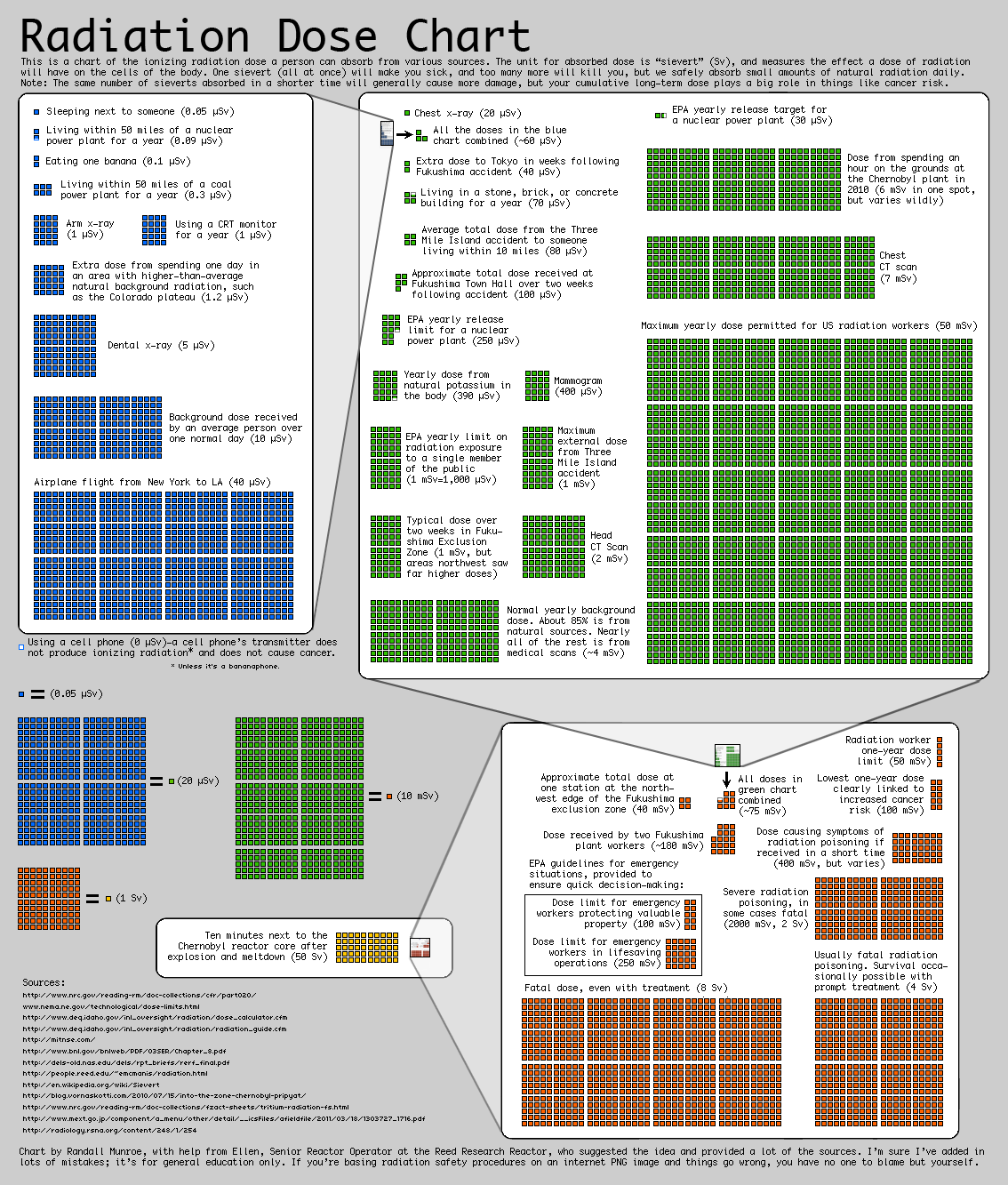
The allowable exposures to members of the public and to radiation workers are given in the chart by Randall Monroe (XKCD). For a member of the public, 1 millisievert/year (mSv/year). For a radiation worker, 50 mSv/year. Under extreme conditions, the worker’s exposure could go up to 100 mSv while protecting valuable property or 250 mSv in protecting human life. That’s, as the news articles like to say, a factor of 250 in exposure. But what does it mean for the risk of cancer?

Let’s consult BEIR VII again. For this post, I want to make the numbers as plain as possible, so I will omit most qualifications. There are many in BEIR VII, and I will discuss some of them later.

The most directly usable tables are those in Chapter 12 and Annex 12D. They provide the lifetime attributable risk of cancer incidence and mortality for single exposures at various ages. “Lifetime attributable risk” means those cancers attributable to radiation over and above the normal cancer incidence. BEIR VII assumes that the risk is proportional to the amount of exposure, the linear no-threshhold hypothesis. This hypothesis is the subject of some controversy, which BEIR VII addresses and concludes that it is a reasonable assumption. It is a conservative assumption, because it results in a higher calculated risk of cancer than alternative assumptions. So the numbers in this post might be considered an upper bound.

The tables also give the exposures in grays, rather than sieverts. Gray is the measure of deposited energy, and sievert is the measure of biological effect. For most of what I’m considering, it’s reasonable to assume that the two are numerically equal.

For the public limit, the BEIR VII committee’s preferred estimate is in Table 12-6. 1 mSv per year throughout life, the expectation is that there will be 550 cases of cancer and 290 deaths per 100,000 males, 970 cases and 460 deaths per 100,000 females. due to this incremental radiation exposure.

The worker limit, 50 mSv per year, does not apply to an entire lifetime because people do not work over their entire life. Table 12D-3 provides data for yearly exposures of 1 mGy per year throughout life and 10 mGy per year over ages 18 – 65. It is evident in the table that cancer incidence and death rates are not a simple multiple of the exposures, but I will use that method anyway; it gives a high estimate. For 50 mSv per year exposure for men, the risks for cancer incidence and mortality are 15,295 and 8,500 per 100,000 people; for women, the corresponding numbers are 21,475 and 11,945. But most workers are not exposed over that entire time range, nor do they receive the full 50mSv per year. Although my work with radioactive materials was occasional rather than the regular work of, say, a reactor technician, my typical exposures were under 1 mSv per year.

The lifetime attributable risks of cancer incidence and mortality of the one-time doses, 100 mSv for protection of valuable property and 250 mSv for protection of human life, are found in Tables 12D-1 and 12D-2. If we assume that the workers are male and their age is 40, then 100 mSv gives 648 cancer cases and 337 cancer deaths per 100,000 people exposed; 250 mSv gives 1620 cancer cases and 843 cancer deaths per 100,000 people exposed.

The incidence of genetic mutations is so small that BEIR VII does not include an attempt to measure it.

Doses over a lifetime are not strictly additive, although this claim has been made in the media. The BEIR VII tables indicate different effects for one-time doses and doses over time. Radiation therapy for cancer frequently involved much higher cumulative doses than those expected to cause death in a single exposure.

My next post will consider the likely errors on these numbers, the qualifications stated in BEIR VII, and some questions raised by others about BEIR VII, along with the baseline incidence of cancer. Unfortunately, that last is almost as hard to pull out of the reports as the numbers on radiation effects I’ve given here. For some comparison, Ethel S. Gilbert, a radiation epidemiologist at the National Cancer Institute, was quoted in the New York Times on the cancer risk to Americans from fallout from atmospheric nuclear weapons tests. That projection, apparently the same sort of numbers as what I’ve given above, is 11,000 more deaths from solid cancers compared with the normal rate of 40 million cancer fatalities.

Cross-posted at BMJ Blog.

This post should be read in conjunction with "Limitations of BEIR VII Estimates of Radiation Risk."

Wednesday, May 04, 2011

Bits and Pieces - May 4, 2011

Let the hand-wringing start. I'm on an e-mail list that includes a number of people who find the US wrong no matter what. So they now are trying to convince themselves that the US killed Osama bin Laden in cold blood, illegally, should have brought him back alive for a trial. Here's some other opinion on the matter, the way I'm leaning:

From a United Nations human rights expert who has severely criticized Guantanamo.

From Stephen Walt.

Added later: As usual, John Cole makes a lot of sense.

Juan Cole comes at the issue in a slightly different way.

Gary Sick: Does Islamism have a future?

Tuesday, May 03, 2011

Bits and Pieces - May 2, 2011

Tracking bin Laden as a class project.

Many thanks to Ezra Klein for summarizing Bruce Schneier's TED talk. I'm just not fond of watching video on my computer, except for events in progress, Jon Stewart, and Steven Colbert.

Get up early and see six planets.

Who is it who wants to impose sharia on the United States?

The Obligatory Bin Laden Post

Yes, the title isn't even original. I saw it yesterday somewhere, and when I googled it, many more turned up. It's not clear to me that I have much to add to what's being said.

As far as global strategy goes, most of the possible analyses have been given. If I'm not going to comment on something, I usually like to provide analyses that I've found worthwhile, but I'm unimpressed so far. Osama had become less important to his now-franchised al Qaeda, and the young people in the Arab uprisings have other agendas.

The TSA isn't going away and will insist that you be x-rayed, your liquids and gels limited, and your shoes off, just like a convict, just like yesterday and the day before.

It does seem that the Republicans have lost some political purchase. No longer can they accuse a Democratic president of fecklessness, his having gotten the man that their president gave up on. I'm wondering if this will set them back enough that they become slightly more rational in issues like the debt ceiling, but they, like Osama are true believers to whom anything like reasonableness is a defeat.

Pakistan may have some rethinking and explaining to do, but it looks like the US and Pakistan have decided to try to ignore the more uncomfortable facts for a while.

I guess I ceased to think of the search for Osama bin Laden as being meaningful some long time back. I've never been impressed with the "great man" theories of history, and I never thought al Qaeda to be the existential threat that some desired. It's mostly a relief to have that box checked, off the agenda, so that we can move on.

Good job by everyone involved: the national security group in that photo that's making the rounds, and all the military and CIA involved in the operation.

Afterthought: Another thing that isn't going to change, might get worse, is that The Terrists Will Attack Us. With WMD. Their desire may increase, but their capability is likely to go down, particularly now that Osama's computer is in US hands. Now that the Armchair Generalist has gone silent, I may have to polish up my snark for this sort of thing. I'm particularly disappointed that this warning came from Richard Lugar, who has been a voice for sense on nuclear weapons.
Sigger's Law: "As any discussion on terrorism grows longer, the probability of attributing terrorists with nuclear weapons (or similar destructive capabilities) approaches 1." Corollary to Sigger's Law: "Once such an observation is made, the discussion is finished and whoever mentioned terrorist possession of nuclear weapons has automatically lost whatever debate was in progress."

Sunday, May 01, 2011

Fact-Checking Helen Caldicott

Helen Caldicott was in Santa Fe a week or so after the Japanese earthquake. A friend suggested we go to hear her speak, and I went along, although I knew I wouldn’t agree.

I didn’t bother to write down every statement that needed checking – they came every minute or so. She was quite clear and accurate on the basic physics and chemistry but then went off into opinion on pretty much everything else. And some things were just wrong.

The structure of her speech was like a preacher’s “come to Jesus”. There was fear of radiation and guilt on everyone present for not ending this terrible situation immediately. She omitted the altar call at the end, although she mused about entertaining questions and decided not to “break the mood.”

The talk was sponsored by one of our local antinuclear groups, so she was given a standing ovation. Another friend sitting nearby said “Don’t fact check, but she’s good.” I pressed him on that; he knows the importance of fact-checking. “We’ve got to get rid of the nukes, one way or another” was his answer.

I want to see the numbers of nuclear weapons decreased and eventually eliminated. I want to see nuclear power developed safely. But Caldicott’s tactics don’t lead to the kind of world I want to live in.

The New York Times has given her an op-ed today. What she says there is very similar to what she said in Santa Fe, and what I’ve seen in her other op-eds and videos.

What she says has a number of problems. George Monbiot recently documented many of them at his blog and columns (here and here). I’ll work through a few from the op-ed.
Six weeks ago, when I first heard about the reactor damage at the Fukushima Daiichi plant in Japan, I knew the prognosis: If any of the containment vessels or fuel pools exploded, it would mean millions of new cases of cancer in the Northern Hemisphere.
Have you noticed how much of the scariest commentary about Fukushima has revolved around that little word if? Bugs me every time. No, none of the containment vessels or fuel pools exploded. Every day that goes by, that if becomes less likely. Sorry, Helen and all the others who seem to have been longing for the most horrific outcome possible.

But that quote does manage to re-evoke the fear that we felt in the week or so after the earthquake. It paves the way for more credulity about the last part of that sentence. Millions of cases? I’ve been looking in some detail at the BEIR VII report, whose purpose is exactly such prediction. (I hope to have a post with some numbers in the next day or so. It’s taken me a while, because I’m trying to understand what they’ve done in some depth.)

It won’t be millions of cases of cancer. Mainly because those explosions didn’t happen and probably won’t. But even if they did (beeee veerry afraid!), the numbers aren’t likely to be that high.
During the 25th anniversary last week of the Chernobyl disaster, some commentators asserted that few people died in the aftermath
Ah, those shadowy anonymous commentators, who can’t be traced! They would include the authors of BEIR VII and the researchers who provided some of the data those authors used.

The only source that Caldicott actually names, a report from the New York Academy of Sciences, is a translation of a Russian report that hasn’t undergone the same sort of peer review that the BEIR VII and other reports have been subjected to. It stands alone in its very high estimates of damage. Here’s one critique. Caldicott needs to address why she has chosen this outlier report over other available material.

The stories about deformed fetuses and genetic damage are heart-wrenching. Nobody wants babies to be deformed. BEIR VII looks for genetic damage and finds not enough to be treated statistically, as cancer cases can. Miscarriages? Has there been a study to show that there were more than normal? Again, Caldicott provides nothing that is checkable, only assertions.

Caldicott sets up straw physicists and attacks them with statements that are simply untrue. There’s something wrong with every paragraph. Just one more for now:
Still, physicists talk convincingly about “permissible doses” of radiation. They consistently ignore internal emitters — radioactive elements from nuclear power plants or weapons tests that are ingested or inhaled into the body, giving very high doses to small volumes of cells.
The authors of the BEIR VII report are physicians and health physicists, who I’ve always found to be closer to the health side than the physics side. And that report doesn’t ignore internal emitters, nor do other similar reports. Those internal emitters, incidentally, include potassium-40 that is a natural part of every living thing.

It’s easy to say that there is no safe dose of radiation. That’s not really proved; BEIR VII assumes that the probability of developing cancer is proportional to the dose, but they are clear that it is an assumption. It’s true in the same way that no amount of automobile exhaust is safe or char on barbecued meat is safe. It’s also easy to say that radiation exposure is additive, but the numbers in BEIR VII don’t support that. Radiation treatment for cancer may involve doses of tens of thousands of rem, which would kill if absorbed all at once.

Much as I agree with some of Caldicott’s goals, I don’t want to live in a world in which fear and guilt are primary motivators for political action. Even Caldicott suggests that guilt is an inappropriate motivator for her stereotyped physicists. It’s fact we need, and Caldicott provides little of that.

Ciriguela

Saturday, April 30, 2011

Bits and Pieces - April 30, 2011

One of the things I love about the internet is that I get to meet people I wouldn't have otherwise. Here are a couple of artists worth knowing.

Jeffrey Lewis tries to track down a quote attributed to Enrico Fermi. I guess I haven't paid enough attention to that one; I would have attributed it to Edward Teller. I've certainly heard it from his students and acolytes enough times.

Dana Milbank breaks with the cool kids.

Bad news! The Armchair Generalist is going silent.

What we might learn from the Greg Mortenson debacle: "the search for the next killer app or the next big star makes us vulnerable to fads and, simply, to the characteristic failures of many organizations focused on a single person or a single gripping idea." Journalists, are you listening? Progress is more often incremental, boring by newsy standards.

Thirty-six years ago today, the Marines left Saigon. The predictions of what would happen next were as dire as those about Afghanistan today. And they were wrong. Something to think about. Government policy folks, are you listening?

So this gorgeous female who is interested in missile technology wants to be your friend on Facebook and follows you on Twitter? What do you do? Give her the secrets she asks for, of course, if you're a guy. Hey, it's worked before.

Friday, April 29, 2011

India: Still Unique

One of President George W. Bush's brave ideas was to normalize nuclear trade with India. India would be a counterweight to China in Asia. India is the world's largest democracy, so there would be much commonality to its interests and America's. And normalizing trade would help to bring India within the ambit of nuclear restraint that most of the rest of the world has accepted through the Nuclear Nonproliferation Treaty (NPT).

Those were all more or less explicit justifications for the negotiations between the United States and India in 2006 on nuclear trade. The NPT banned nuclear trade with nations that didn't accept its constraints, but Bush was forging a new world, outside the requirements of those treaties that constrained the United States' great power. And he knew best.

Less discussed was the role of the various lobbies in pressing for the trade agreement: the nuclear industry, the Indian-American lobby, and, of course, the defense industry. The reasoning was that a favorable relationship with India would bring big bucks to the nuclear and defense industries, undoubtedly part of the argument by the Indian-American lobby. India was looking for military aircraft, in particular. India would be so grateful for the opening of nuclear trade by its great friend the United States that much of the business would go in that direction.

And today we have the outcome.

New York Times: U.S. Loses Bids to Supply Jets to India

Washington Post: U.S. firms lose out on India fighter jet contract

It was quite clear throughout the negotiations that India would follow the path it has always followed: Indian interests, with a certain flavoring of self-righteousness, come first. India will make the very best choices for itself, which will be the very best choices for the world. That's not very different from the way most nations negotiate, although India tends to be more explicit about that. President Bush wanted a deal very badly, and from many accounts, ordered the negotiators to give the Indians what they wanted. And they did.

India's approach to the fighter jet deal is not different from the correspondence I received from Indian nuclear weapons advocates back in 2006: India is beholden to no other country. That has been the nucleus of India's objection to the NPT. So, given an extremely weak negotiation by the US resulting in a deal highly favorable to India's nuclear weapons program, today's result should surprise nobody.

How Many Roads?

Back in the 1960s, I took "The answer, my friend, is blowin' in the wind" to mean that soon, any day now, some of those things would come to pass. And some of them sort of did.

Wikipedia says there's an ambiguity to "blowin' in the wind." I've always been an optimist and still don't feel the downside.

That's fifty years on, now. Back then it was a bit more than fifty years on since Reconstruction, a hundred years now. And we still have racism that's willing to be right in our faces. You know what I'm talking about, the birther nonsense, the still-too-common slurs that those darker folks just can't be as good as us whities.

I just don't get it, and it's seemed that the people who were born back then, when a new world seemed to be blowin' in the wind, seem less willing to get it, too. We've got one of the best and smartest presidents we've had in some time. Lovely family and family values, too, if by family values you mean loving and encouraging each other toward the best they can be.

I've experienced a mild version of what's going on, and it seems as if the prejudices toward women are flaming up again too. But that's prejudice light compared to what's going on with Donald Trump and the demands for President Obama's birth certificate. It's never enough. Place highest on the tests, live an exemplary life, no, we need to see more, you need to jump one more hurdle, then another and another. Even being elected President isn't enough for them.

I think that Juan Cole and Baratunde Thurston have provided the best commentary.

But I disagree with Thurston on one thing. I think that President Obama easily showed himself to be the better person this week. It probably won't stop the racists; maybe the rest of us can help with that.

And here's another place we need to be working to eliminate racism.

Added later: Jeff Danziger gets it right.

Thursday, April 28, 2011

Andiróba

What Haunts Yoo at Night

TPM:
Torture advocate John Yoo thinks that the President of the United States has the executive power to order a village of civilians slaughtered. But force federal contractors to disclose their political donations? That's a bridge too far.
In an editorial former Bush-era Justice Department official Yoo and David Marston wrote for the Wall Street Journal, the authors argued that the "only purpose" of an executive order being considered by President Barack Obama to require companies seeking federal contracts to disclose political contributions "is to dangle the specter of retaliation.. and harassment."
If a small businesswoman wants to sell paper clips to the Defense Department, Mr. Obama would force her to reveal contributions to groups such as Planned Parenthood or the National Rifle Association. These donations are obviously irrelevant to whether she made the most reliable bid at the lowest price.
While the editorial says that the order "represents the latest salvo in the Obama administration's war on the First Amendment rights of its political opponents," there's no word from Yoo on whether the President has the executive power to torture executives to force them to disclose their political donations.

Tuesday, April 26, 2011

Chernobyl

Twenty-five years ago today, I was working on the chemistry of flame and flame suppressants. I got a phone call (not much use of e-mail then) from the Los Alamos Director's Office to attend a meeting on the events at Chernobyl. That phone call probably came a day or two later; it took some time for the world to realize what was happening in the secretive Soviet Union.

It turned out that there wasn't much I could contribute; dumping limestone, boron compounds, and other solids on the smoking reactor zombie was probably the best path and what was eventually done.

The Guardian has an article on what I've been thinking, as a result of my forays into the BEIR VII report: much more research is needed into the consequences of Chernobyl. The terrible numbers you will read in some places today are almost certainly incorrect; BEIR VII concludes that the results are pretty much what might have been expected, except for a higher number of thyroid cancer cases. Chernobyl is located in an area that historically has seen high incidence of goiter, a result of iodine deficiency, which may be part of the reason for those additional thyroid cancer cases.

I'm half-listening to a White House conference on energy security as I write this. Nice words are being said, especially by Jane Harmon, formerly of Congress and now at the Woodrow Wilson Institute, about the complementary roles of industry and the national laboratories. Conservatives and the business community, however, haven't allowed that to be the case for thirty years or so. Back in that Chernobyl time, I was fighting off arguments that industry could do what I was doing much better. They eventually, with the aid of internal fighting within the DOE complex, won. And, twenty-five years on, the technology I was working on is as dead as it was when I came to it in 1986, also under the influence of industry.

So I'm not holding my breath that we'll learn what we could about radiation hazards from Chernobyl. The Republicans would probably eliminate all research, so that they can make their cases unimpeded by fact. And beeee veeery afraaaid of the deficit!

Some more links about Chernobyl from Dan Yurman.

The Women of Chernobyl. Some things to think about in balancing radiation risks against having to abandon one's home.

Not about Chernobyl specifically, but a ridiculous result of some of the fear about stuff people don't understand.

Poly Styrene

1957-2011

Sunday, April 24, 2011

A Question and Some Answers

Daniel Little works through some of the numbers on income per percentile of the American population and asks
The big mystery is -- why do the majority of Americans accept this shifting equation without protest? And how can progressive political organizations and movements do a better job of communicating the basic social realities of our economy and our democracy to a mass audience? Social justice isn't a "special interest" -- it is a commitment to the fundamental interests and dignity of the majority of Americans.
David Kaiser suggests an answer:
The United States and much of the world are suffering from a terrible crisis of authority, both because of an increasing emphasis on individual self-expression, and because the intellectual basis of authority has been destroyed.
....
It is a great irony that participation at the highest levels of our society has been opened up to women, minorities, and gays during the same period in which the idea of "common good" has gone into eclipse.
I'd add another factor I haven't seen mentioned elsewhere. It's a variant on the "bread and circuses" theme. You're unhappy with your life? Not making enough money? But you're better than...somebody. Fill in the blanks; Rightwingers have used all the usual scapegoats, those that Kaiser mentioned, Muslims, and probably some that don't spring immediately to my mind.

The moral indignation machine has been revved up. But hate has a "use by" date. It gets old after a while, particularly when the dire effects of those slated to be hated don't materialize and some of them live down the block. So another target has been found.

I manage my household respectably and pay my debts. Why shouldn't the national government? They're embarrassing me by doing something I wouldn't do! I'm better than those slobs in Congress! Let's show them a thing or two!

Of course, as any number of commentators have pointed out, this morality doesn't transfer. But it keeps people from sitting down and thinking about the reality of their situation.

Blood Orange

Photo by Eric Hill, Wikimedia Commons

Friday, April 22, 2011

Bits and Pieces - April 22, 2011


How low are taxes? Too low.

David Frum concludes, with Irving Kristol and Bismarck, that the welfare state is consistent with conservatism.

Is it just me, or is there an awful lot of fantasizing these days? Pan-Arabism is back in fashion, although perhaps not among the Arabs. We shall see, I guess.

Here's a map of actual measurements of radiation from the Fukushima reactors. Whatta concept, NRC and NYT!

Frank Munger thinks back to the dearth of information on Chernobyl while it happened (anniversary April 26).

Thursday, April 21, 2011

Bits and Pieces - April 21, 2011

I'm still struggling with BEIR VII, to try to get some numbers out on what the various radiation exposures associated with Fukushima mean in terms of people's health. In that regard, the far too many units used to describe those exposures are the subject of four posts at the American Nuclear Society's Nuclear Cafe by Stewart Brand, Steve Aplin, Mimi Limbach, and me.

I'm kind of sad to see Russia pulling out of the International Science and Technology Center, which funded former Soviet scientists to do non-weapons work after the breakup of the Soviet Union. I worked with a group at the Institute of Nuclear Physics in Alatau, Kazakhstan, who were funded by the ISTC to assess the radiation risks at the Semipalatinsk Nuclear Test Site and was extremely impressed by their work. But perhaps the need for external funding has lessened in Russia, and it would be condescending to continue this program. Nothing lasts forever, and this program was intended to deal with the particular conditions of an extraordinary time.

Back in the United States, former New Mexico governor Gary Johnson has thrown his hat into the already crowded Republican presidential ring. There was a time, maybe as recently as a year ago, when I would have said that Johnson was too kooky to be a serious presidential candidate. No mas. As far as I can see, his biggest disadvantage is that he's not being paid by Roger Ailes.

Wednesday, April 20, 2011

Another I-Told-You-So

TEPCO has retracted the chlorine-38 measurements they published a couple of weeks ago.

There was much chortling over those measurements, because about the only way you could get chlorine-38 would be if there were "re-criticalities," if the fuel in the reactor cores or possibly the fuel pools were becoming critical again. I pointed out the improbability of such things happening.

I hope that now those who were looking for the worst will retract their overblown interpretations of China-Syndrome-type meltdowns, fires in the fuel pools, and those unexplainable "localized criticalities."

This is why I haven't been rushing to interpret every single number that comes out of Japan, particularly when it's a stand-alone number like the chlorine-38. The demand that TEPCO release all its information (first comment on Jeffrey Lewis's post) is out of line. If people weren't rushing to be the firstest with the worstest, they wouldn't have to feel dumb when the conclusions they've jumped to turn out to be incorrect. And radiation-measuring instruments are prone to error.

Plus, you know, the people they're asking to provide all that had, like, an earthquake and a tsunami, as well as some reactors to take care of?

Tuesday, April 19, 2011

Your Chart For Today


Can't be said enough: Let the Bush tax cuts die!

From the Center on Budget and Policy Priorities via Ezra Klein. And read Ezra's piece.

Monday, April 18, 2011

Bits and Pieces - April 18, 2011


Happy Tax Day from John Cole!

Paul Revere's ride was 236 years ago today.

Tepco provides their plan for the next six to nine months to get all the reactors to cold shutdown. What's here and in its links needs an enormous amount of detail worked out. But they wouldn't necessarily make all that public.

A few weeks ago, the president of the American College of Surgeons wrote an editorial urging the value of semen's biochemicals, properly absorbed through a woman's mucous membranes. Unprotected sex, in other words. After some uproar, he has resigned as president. I'm still wondering why he thought writing that editorial was a good idea.

A former senate staffer writes his experience with that 1979 event in the South Atlantic Ocean that was detected by a VELA satellite. It's one more tiny piece of the story. I'm looking forward to when we'll hear all of it: did Israel and South Africa warn the United States? Did our intelligence know?

Saturday, April 16, 2011

Bits and Pieces - April 16, 2011

Dan Yurman has been anticipating some of the posts I'd like to write on Fukushima and frequently doing a better job than I might have because he has more connections in the business community than I do. Here's a good one on how some of the big nuclear companies are salivating over the prospect of the eventual cleanup and what the NRC might have known and when. On that last issue, I am becoming more convinced that the New York Times map that showed deadly radiation doses out to the same radius NRC Chairman Gregory Jaczko was concerned about was in fact the modeling that he was relying on in his testimony to Congress that undercut what the Japanese government was saying. I also have suspected for some time, and Dan's post seems to support this, that one of the assumptions that the Times reporters didn't bother to question was that at least one full reactor core and one fuel pond were completely vaporized and distributed fairly uniformly. It's been clear for some time, even as the Times published that map, that that was an extreme worst case.

More photos of Fukushima damage.

And now for some thoughts on rampant marketism.

Bruce Bartlett, who was run out of the Republican Party for having the audacity of rationality on economic issues, has collected a great number of polls on Americans' feelings about the deficit and government spending. He makes a case that they don't like the first and do like the second but haven't put those two ideas together yet. However, it does seem that when faced with facts relating the two, they recognize a need for taxes, particularly on other people. Since "other people" include the 1% who have gotten most of the tax cuts over the last decade and are taking in 50% or more of the country's income, this actually makes a lot of sense. That number was not intended to be factual, but rather indicative of the wildly disproportionate wealth in that 1%. I keep seeing it written in different ways, and it's just too sickening to think about it enough to recall the exact number.

The miracle of the invisible hand deconstructed.

Back when I worked for an organization whose product was nuclear weapons, it occurred to me that there are some functions that probably should be left to the government. But we've gotten past those old inhibitions, and that organization is now managed by some of the same folks who are salivating at the $12 billion estimated for the Fukushima cleanup. It turns out that, silly me, I'm still stuck with that idea about the market not being the measure of all things. Here's another place where that seems to be the case. Could there be a conflict between the Hippocratic oath and making a buck?

Friday, April 15, 2011

Bits and Pieces - April 15, 2011

Roger Ebert reviews "Atlas Shrugged."

Seems to me that the solution to these two problems is for journalists to understand what they're writing or talking about. Clothes make the interview. "He said, she said."

Want an itemized receipt for your taxes? Here is is.

Senator Dick Durbin (D, IL) takes down Jamie Dimon (pdf). Nice to see a legislator who understands the laws he's proposing.

Wednesday, April 13, 2011

Seven Out Of Seven

I have avoided saying anything here about the INES rating scale for nuclear accidents, because I don't think it's worth discussing. I've mentioned before the penchant of reporters for simple ways to report complex stories, condensing them down into a single number if possible. For those people, the INES rating scale is a godsend, as well as for the people who have been salivating for "another Chernobyl," something that seems to have started well before the Japanese earthquake.

But I'm encouraged by the news coverage of the one-number approach. Actually, I think that the media overall have done a pretty good job of covering Fukushima. They're having a hard time conveying risks, but let me tell you how long it's taken me to write my last couple of risk posts...

BBC News compares Fukushima to Chernobyl. The Christian Science Monitor discusses some of the objections to the INES scale, most of which I share. And the Russians are wondering whether the Japanese are exaggerating for financial reasons.

It's not clear to me what the purpose of the INES scale is, other than aiding lazy journalists. If it indeed winds up having to do with insurance, government aid, and other financial help, then there is a motivation to exaggerate, as the Russians point out.

So this is part of the story I'm not paying much attention to. What is actually happening at Fukushima is what's important.

Added later: Photos of tsunami damage at Fukushima.

Monday, April 11, 2011

Bits and Pieces - Graphical Edition


America's military expenditures, via Ezra Klein.

Fukushima temperatures, pressures, and water heights in graphical form. The other pages have good stuff, too.

Another chart on radiation levels (h/t helmut).

The BEIR VII Report

I’ve been looking for numbers. What is the probability of a radiation dose of x millisieverts producing a cancer?

I should have found the BEIR VII report, BEIR standing for Biological Effects of Ionizing Radiation, some time ago. It’s been almost twenty years since BEIR V was a constant background presence at my job, the guide for understanding the radiation that my workers and I might be exposed to, one of the small number of studies used by governments to develop exposure standards. I happened on it quite accidentally, a week or so ago.

Over the past week, I’ve been reading that almost 400-page report. Well, not quite reading the whole thing. I’ve skimmed through sections, checking to see what kind of data it includes and how the data are treated, with ranges of error, reading the conclusions and summaries to check that I’ve gotten my skimming right. I read Chapters 11 and 12 carefully, on their risk assessment.

It’s important to understand how the BEIR VII committee did their work. I’ve done the kind of thing in my research that they did. It’s is some of the hardest work that scientists do, connecting the macro to the micro in order to derive a systematic understanding, in this case, of how radiation causes harm to the human body and how that risk can be quantified. In my case, the issue was how catalysts work. It requires building a framework of the best data, bridging between macro and micro.

That framework connects a wealth of epidemiological and laboratory data in order to predict, in the case of BEIR, the human health risks of radiation, and, in my case, how to design catalysts to facilitate particular chemical reactions. My project was much smaller than BEIR, and I won’t say more about it. Success in such an endeavor is not an exact fitting of every data point to an infallible prediction. Success is providing a simple and consistent model.

BEIR’s macro is a number of studies of humans who have been exposed to radiation. The micro is studies of cells in vitro and animals exposed to radiation. The ideal model would work from the kinds of radiation damage to cells as a function of type and energy of radiation, through the steps from that to cancer. The probabilities of the various steps would allow calculation of the risks to an individual or to a population. Unfortunately, the complete chain of information is a long way off. Radiation can result in other kinds of damage, but the data doesn’t support an analysis of those probabilities.

A framework is constructed with the information that is available. Some links in the framework are shorter and stronger than others, and multiple links substitute for certain knowledge. The objective is to form a network in which one bad link won’t collapse the whole structure, and I think that the BEIR VII committee has succeeded in doing this. That is not to say that things might not change in the future, as more information becomes available. But for now, BEIR VII and a few similar reports are the best that we have, and they’re pretty good.

BEIR VII winnows down the large number of studies that have been done.
Epidemiologic studies, in general, have limited ability to define the shape of the radiation dose-response curve and to provide quantitative estimates of risk in relation to radiation dose, especially for relatively low doses. To be informative in this regard a study should (1) be based on accurate, individual dose estimates, preferably to the organ of interest; (2) contain substantial numbers of people in the dose range of interest; (3) have long enough follow-up to include adequate numbers of cases of the disease under study; and (4) have complete and unbiased follow-up. Unfortunately, the published literature on environmental radiation exposures is not characterized by studies with such features. p. 235
The in-vitro and animal studies are also subject to a number of criteria in order to be included.

BEIR VII continues to use the study of the survivors of the Hiroshima and Nagasaki atom bomb attacks as its primary source of epidemiological data. It is the source that comes closest to the criteria above. As more information becomes available from Chernobyl, it seems likely that it will play a bigger role in BEIR estimates. But large numbers of people are needed to study the small effects of low-level radiation.
For example, using the usual criterion for statistical testing in order to detect with probability .80 a 5% increase in risk when the baseline risk is 0.10, the number of individuals at risk in the exposed group would have to be approximately nj,E = 30,000. p. 261
Several other studies, while not fully meeting the committee’s criteria, are examined for their support or lack thereof for the Japanese survivor data. There is support for the most part, but there are some departures. A blog post that appeared on March 30 lists a number of the studies covered in BEIR VII and a few more. It’s interesting, but not of the same reliability as BEIR VII.

The in-vitro and animal studies tend to support the assumption that radiation effects are linearly related to very low doses. This assumption is one of the places where critics of BEIR VII focus; both lower and higher effects have been promulgated.

Which brings me to the subject of cherry-picking. There are enough references in BEIR VII that almost anyone could select the ones that support their viewpoints. The importance of BEIR VII is in its conclusions and how those conclusions are supported; focusing on a single set of data or parts of a reference does not invalidate the BEIR VII findings. The value and meaning of individual references must be taken in context. So be wary of claims that BEIR VII supports particular viewpoints. The report itself is quite clear about its limitations.

What BEIR VII gives us is a working hypothesis, the best we have now.

I’ve given no numbers so far. I think that understanding what BEIR VII does and how it does it is important. Numbers to come in a future post.

[Cross-posted at the BMJ Blog.]

Saturday, April 09, 2011

On the Budget Deal

Steve Benen pretty well sums up my thinking.
A hostage strategy works well when the hostage taker makes it clear that killing the hostage is a perfectly viable option.
And it's worth adding in the paragraph from Matt Yglesias that Benen omits:
I hope people remember this year next time large Democratic majorities produce an inadequate stimulus bill, a not-good-enough health reform bill, a somewhat weak financial regulation bill, and fail to deliver on their promises for immigration and the environment. It’s easy in a time like that to get cynical and dismissive about the whole thing. But there’s actually a huge difference between moving forward at a slower-than-ideal pace and scrambling to reduce the pace at which you move backwards. Now we’re moving backwards.
I'll further point out that this is the budget for the 2011 fiscal year, the year we are more than six months into.

That means, unfortunately, that those who want to return to the golden days of the robber barons, child labor, and health care for those who can afford it will have two more bites at the apple. Or at the populace. That will be when they steel themselves to destroy America's financial credibility in the world by voting against raising the debt limit and when the budget for fiscal 2012 is considered.

The only way we can stop this rampage toward feudalism is to vote the lackeys of the upper 1% out.

Friday, April 08, 2011

Fukushima Threat Down?

The Los Angeles Times reports that the crisis at Fukushima appears to be ebbing, and that at least some US experts believe that the fuel has not melted in any of the reactors.
The most telling evidence about the condition of the reactors is the absence of heavy radionuclide contamination around the plant, which would indicate that uranium fuel became so overheated that it vaporized heavy fission products such as strontium and technetium, experts said.

Instead, the main contaminants have been isotopes of iodine and cesium, which are water soluble and are not held in the uranium fuel itself.
It's those radionuclides associated with fuel breakdown that I've been looking for in the monitoring reports and not seeing. It's important to remember that this evaluation is not final and is based on very limited data. But earlier, breathless reports in the New York Times for example, were based on even less data.

The LA Times article mentions the disarray at the NRC, where Chairman Gregory Jaczko early on recommended a much wider evacuation than did the Japanese government, apparently without consulting them. I suspect that Jaczko's recommendation was based on the modeling represented by the map published shortly after his statement in the New York Times showing deadly contamination out to 50 miles from the reactors. At the Carnegie Conference last week, when asked specifically about this recommendation, NRC Commissioner George Apostolakis said that the recommendation was made "in consultation with staff," decisions were made "in extreme ignorance," based on "extremely conservative calculations." It's been clear for some time that NRC has been trying to walk Jaczko's too-early comments back, and today's LA Times article indicates that questions continue to be asked on this subject.

With every day that passes, the heat load and radioactivity of the reactors decreases. The three biggest cement-pumping trucks in the world are arriving at Fukushima to keep water in the spent fuel pools. I still don't have a full answer to my question on whether water is being recirculated or added open-loop, but the amounts of water suggest that it is open-loop with significant evaporation.

And yeah, this is an I-told-you-so post. I'm not convinced that the scenario quoted in the LA Times is accurate, but the fact that modeling can now come up with a scenario in which the fuel is not all melted and the spent fuel pools did not catch fire suggests that the doomsayers haven't had the full picture and may have been driven by other motives than technical accuracy.

If it's an I-told-you-so post, it's incomplete. I'm headed out in a little while and will try to provide links later. I'm not sure I put as much of my thinking on the blog as I shared with others via email and discussions. But at least some of it is here at Phronesisaical.

Thursday, April 07, 2011

Bits and Pieces - April 7, 2011

A 7.4 magnitude earthquake has shaken northeast Japan. A 1-meter tsunami is expected in the same area that was already hit. The previous tsunami was 14 meters at Fukushima, however. Update: Tsunami warning has been lifted.

How to tell if your neighbor is a bombmaker.

The idea of bringing all nuclear weapon states into some kind of a START-type data exchange arrangement seems to be going mainstream.

I have to apologize to Johnny Depp, the Mad Hatter, Alice, and the rest of the Wonderland crew for my post the other day. The Republicans are much further out.

Added later: US nuclear experts helping Japan. Those guys on the other end of the phone? I hear that Fukushima is the only thing the reactor guys at Los Alamos are doing these days. I might add that if the government shuts down, this support may shut down too, or become more difficult.

And, oh yeah, Russia seemed to be irritated with Iran for safety issues at Bushehr a while back. Iran says not to worry.

Tuesday, April 05, 2011

Bits and Pieces - April 5, 2011

Helmut and I were talking about how badly research funds are needed to develop better energy technologies and to evaluate possible mitigation schemes for global warming. I mentioned the great research boom of the 1960s, in which government led the way. During the 1980s, that approach was destroyed by greedy corporations who said they could do all that, much better than the government. And now we see the results. Ezra Klein has a nice graph illustrating the collapse of research funding. He uses it to make a different point, which I'll address later in this post. I'm wondering if that research boom is tied to the good economics of those times. Any economists who want to tackle this with me, leave a comment or e-mail me.

Ezra is bitching about how President Obama never does what Ezra and many other pundits, bloggers, and just plain gripers want him to do: get in the middle of the fight. Or maybe duck into a phone booth and emerge as Super-Prez! Sorry guys, cellphones have eliminated phone booths. I've maintained that 1) the Prez is leaving the work of citizens up to us and 2) he doesn't want to make every issue about him, which would happen if he intervened as much as the gripers want. It seems to me that I've seen more articles lately suggesting that we citizens need to be making our support (or not) clear to our elected representatives as they make fools of themselves and us, but I've been distracted and haven't collected those links.

Part of this gripe is that Obama isn't getting stuff done. At the Carnegie Nuclear Policy Conference last week, National Security Advisor Tom Donilon listed all the things relating to Obama's Prague speech on eliminating nuclear weapons that have been done in the two years since then. Today is the anniversary of that speech. Scott Sagan gives an accounting here. And the dumbest idea in missile technology has been left behind: loading ICBMs with conventional explosives, so that a recipient country wouldn't know if it was being nuked.

Back at Fukushima, it appears that the report of an isotope beloved of those pushing the "re-criticality" meme was mistaken. As I've pointed out, basing a theory on one measurement is pretty silly in a chaotic situation like this.

I would also take this with a grain of salt. There are a couple of vu-graf sets out there of what some people think, with a bit of modeling, may have been the sequence of events at Fukushima. Like the "re-criticality," this is largely speculation based on far too few data points. "Nuclear forensics" sounds very CSI, cool and accurate, but a friend who has been looking at the iodine isotope data much more closely than I have says that it just doesn't make sense. That could be because the data are bad, or because things we don't understand are happening.

Don't get on George Monbiot's bad side. He's looked at Fukushima and decided that the evidence is that nuclear energy is safe. He's posted two op-eds on that subject in the Guardian and now is taking on Helen Caldicott. I heard her speak a few weeks back and managed to identify some of the problems that Monbiot documents exhaustively. There's more I'd like to write on this subject, too, but I have to get back to BEIR VII.

Do you suppose this tea party is the one they really mean?


Credit

Monday, April 04, 2011

Marula

Bits and Pieces - Not Fukushima Edition

I'm taking a few minutes off from reading BEIR VII.

The changing politics of Russian Jewish immigrants in America.

Stephen Walt: Top 5 reasons we keep fighting all these wars.

Civic optimism: a bygone virtue in California.

Questions about Fukushima

I've been developing a number of questions as I watch the Fukushima news. Any reporters reading this post are free to use them without crediting me. These are what instantly spring to mind. I may have more later.

1. Does the fresh water now being used to cool the reactors and spent fuel ponds have boron added to it?

2. Are the coolant loops been operated in recirculate or open mode? By that I mean whether the water is being recirculated by pumps (new ones have been installed) or whether the water is taken in at one end and pumped out at the other. Or is water added and boiled off?

3. This is less a question than a general wondering about heat transfer issues. Let's say the core(s) were exposed and some damage occurred, perhaps even melting. That would have been at temperatures much above the boiling point of water. Pressure in the vessels makes water boil at somewhat higher temperatures, but adding water to the heated/ing fuel elements made really a lot of steam for a while. Now some of the cores are reported to be partially uncovered by water. But as long as they are partly covered by water, the ambient temperature inside the reactor vessel has to be lower than the boiling point of water at whatever the pressure is. So how much higher than that could the temperature of the exposed parts of the fuel elements go? They're going to be partially cooled by conduction into the parts covered by water.

And I've seen some stuff about temperature layering in the reactor vessel. How about convection? Have the laws of physics been suspended? Generally things have to be pretty stable or big to get temperature layering, as in lakes or the ocean. Temperature layering would be very unlikely if the water is being circulated, or if it's boiling off.

Sunday, April 03, 2011

Post in Progress

I'm writing some more on radiation standards and how they relate to risks. But as I was going through the material, I realized that there was one reference that I had to take into account. That's what is called BEIR VII, the evaluation of relevant scientific studies on the relationship between radiation exposure and biological damage. I've dipped into earlier versions, but I am skimming and reading this one so that I can feel sure I'm representing the science properly.

Meanwhile, Mark Hibbs reports on a panel at the Carnegie Nuclear Policy Conference. The post currently seems to be attributed to Jeffrey Lewis, but it was Mark who was on the panel, and his contribution is unmistakable.

Nuclear power kills fewer people than do other sources of electricity.

Thinking about risk can get mixed up with politics.

Friday, April 01, 2011

Bits and Pieces - April 1, 2011

A non-nuclear post that I'd like to blog more on but probably won't be able to.

George Monbiot: The double standards of green anti-nuclear opponents. This is an opinion piece. I've tried to stay away from posting primarily opinion pieces. It's almost impossible to avoid inserting my opinion at times into the discussion of Fukushima; as I noted in an earlier post, a certain amount even of setting radiation standards is judgement. This piece from Monbiot is significant because he has shifted to being in favor of nuclear energy as a result of the Fukushima incident.

A short and simple explanation of radiation that covers some things I haven't.

A very long post on the evidence for radiation effects on humans. This post and the previous one lead up to what I hope to write over the weekend about the radiation levels at Fukushima. This one pulls together a lot of information that I will use as a jumping-off point.

And TEPCO is reviewing its rad data. I guess I'm not surprised. This stuff is complicated enough that errors will be found as long as the incident is investigated.

Added later: Public Safety Alert from Michael Berubé.

Numbers, Please!

Something that some have been anxiously awaiting to see at Fukushima is "re-criticality." It's also referred to as "localized criticality" or "episodic fissioning." I've read descriptions that make it sound as though the fuel elements are dripping pieces with sparks of neutrons, light, and other scary things.

So far none of those proclaiming it have provided persuasive explanations, with numbers.

In order to have criticality or fission (with one exception, which I'll explain later), there must be a critical mass. The water being injected into the reactors has boron in it, and the fuel elements are spaced to allow water flow around them. The boron absorbs neutrons and prevents fission. So "re-criticality" isn't happening in fuel elements that retain their original configuration.

But the tops of the fuel elements are exposed in the reactors. So they can heat up (although the partial immersion will help to remove heat from them) and deform or break open. At worst, if they are suspended from the top, they may break off and fall to the bottom of the reactor vessel. Or small pieces may fall to the bottom of the vessel. The fuel pellets within the fuel elements are centimeter-sized. They are oxides and have very high melting points.

If fuel pellets come out of the fuel elements, each contains a small amount of uranium or plutonium and is incapable of becoming critical. Some large number would have to accumulate in the proper configuration without borated water between them to form a critical mass. And if that were the case, criticality would continue; it wouldn't be a flash.

If the fuel elements break off and fall to the bottom of the reactor, it seems unlikely that they would form critical masses. They would have to fall into a very orderly pile, and, again, criticality would continue.

It may be a lack of imagination, but I just don't see how you could get small bursts of criticality, and I haven't seen the proponents of "re-criticality" provide as much thinking-through as I've given here, let alone numbers for what the critical masses might be (they depend on configuration) or how critical configurations might occur.

The one exception is whatever plutonium-240 might be in the reactor. Plutonium-240 spontaneously fissions, but it is present in very small quantities. I'm wondering if the alleged activation products result from plutonium-240 neutrons, but, like those making that claim, I haven't looked up the numbers. The next things I want to do will require numbers, so that may take a little time. And I'll try to check this as well.

Starting Slowly

I'm back from the Carnegie Nuclear Policy Conference in DC with a ton of material and thoughts which need to be arranged in some reasonable order before posting.

So for now, I will introduce you to one of the mysteries I have found in Estonia. The Estonians have no generic word for bread, and now they've introduced one more specific.

Also, some high-resolution photos of the Fukushima site from drones. I can't see much inside the wreckage, and, from what I know of reactor containment, I'm guessing that the debris did little damage.